 Español
May 17, 2026
Previous chapters
by Jan Baross
CHAPTER FOURTEEN
The stars are so close, my nipples would graze them if I took a deep breath. A sea breeze salts my face. Blossoms pungent as night cling crab-tight to the shingled trunks of palms.
Ahead of me, Miguel Svendik stares out at the sea road and nudges his heel into the camel's neck. Her hooves kick up dust under us. The back of Miguel Svendik's white shirt is solid as moonlight. His hips sway one way then the other. He is a slow dancer, back and forth, side to side, broad shoulders, thick head of hair unstirred by the breeze.
My thoughts rock back and forth with the rhythm of Miguel's hips. Back down the road toward El Pulpo, Mamá, Papá, all of them will be sleeping. Papá's good aguardiente will be pissed into the earth by morning. The bruises I left on Mamá's days will heal now. I wonder if she will forget me.
The future is the clean white slate of my husband's back. He knows nothing of what I carry into his village. In my new home, I will bury my disgraces from the past deep inside and create anew who I am. Until I am discovered, I will be Señora Perfección.
"Hut, hut," says Miguel.
Lucinda picks up her pace through swaying palms on either side of the road. To the left, the beach is bright and blinding. The sand is a chalk-white pasture of moon and damp smells from a silver estuary.
Miguel Svendik glances back at me, dark eyes, under dark brows, under bright moonlight. Securing Lucinda's reins to the supplies, he turns his legs and his thick body around to face me, knees to knees. He pulls his white shirt over his head and unties the front of his pants as easily as if he had disrobed on a camel every day of his life.
I have never seen a man this naked before, and the shock does not let me think beyond the parts of him. I try not to stare at the dark triangle of hair in his lap. His snake lies somewhere in the shadows. Moon lights his hairy, oxen shoulders.
"You look like livestock," I say.
He laughs. "My little virgin."
He reaches for my legs, pulls me toward him, and slides off my underwear. I am barely balanced. He allows my legs to return to either side of the camel and arranges my underpants on his head like a white cap.
His hairy fingers spider under my dress. There is no possibility of rescue. No Gabito in sight. Ahead are pale dunes, cold and hard as plaster.
I shut my eyes and try not to mind the slow approach of his walking fingers toward my woman's mound.
I hear a familiar cough. When I open my eyes, Gabito is floating behind Miguel's shoulders. Even the good side of Gabito's face turns ugly as he surveys Miguel's nakedness and my underwear on his head.
"Tortugina, you're killing me all over again," says Gabito.
I look over Miguel's shoulder at Gabito and say aloud, "You must know in my heart I will always be yours no matter what the rest of me must do."
I pucker an air kiss to Gabito, who breaks into open sobs.
"My eager bride," says Miguel.
Miguel shifts forward, so close I can smell his long journey to find a wife, his smoky nights roasting small animals under the stars.
His fingers shake with the one button of my blue cotton skirt. We both watch it fall open around my hips. He pulls my blouse over my head. The damp night chills my nipples.
I cannot shut out Gabito's sobbing. I feel ugly, having him see me sitting naked before a strange man. My arms seem monkey-long.
"Do not be afraid of me, Tortugina," says Miguel. "I am only in a hurry."
Miguel reaches down the side of Lucinda and gathers a leather water bag. He wets a rough cloth and washes his face, his underarms.
"I clean myself for my bride," says Miguel. "A man must be clean before he comes to a woman for sex. Even if she is his wife."
Miguel holds the wet cloth to me.
"Tortugina," he says. "Would you like to wash the part of me that will enter you?"
Gabito's voice fills my head with a high whine.
"Tortugina," says Gabito, "it is a man's job to wash his own burro!"
"Gabito, go away!" I say only to him.
He disappears suddenly. Lucinda's hooves clack loudly against dead palm branches scattered on the road. Gabito's slender shadow is no longer floating beside the camel or flapping over the white sand.
"What are you looking for?" says Miguel. "We are alone, Tortugina. No one is on the road this late. Would you like me to wash you?"
On the road just ahead of us, small waves break and streak up a stretch of wet sand. Gabito stands shirtless with a rage so blistering his face illuminates a small stand of palms. As we reach him, he scoops into the ragged gash of his chest and pulls out his beating heart. He holds it up into the moonlight for me to see.
"NO!" I yell and startle Miguel.
Gabito throws his severed heart on the dusty road in front of Lucinda as we pass. The camel hoof crushes into the bloody heart, making a moist butcher sound.
Miguel's fingers squeeze my knees.
"Tortugina, what is wrong?" says Miguel. "You are so pale."
I look back down the road for the flattened heart, but I see only dunes turning a dull gray as a thin cloud covers the moon.
Miguel smiles and reaches for my hand.
"Tortugina," he says, "let me introduce you to Angelicus Maximus."
He slips my hand into the untied front of his pants and wraps my fingers around the dark snake between his legs. It is soft and damp.
I am backstage, and this is the puppet I have never seen—this secret thing that bulges and deflates with regularity behind the curtain of men's pants. It is not raised by levers or lowered on ropes. Awakened from its slumber, Angelicus Maximus grows hard and silky and salutes a woman's touch. My fingers barely wrap around the hardness bloated on blood. How big can it get? It does not seem a lot different from a burro's, though a burro's is black and reaches nearly to the ground. It is larger and darker than a pig's or a monkey's or a dog's. And there is a distinct pulsing. I have never been so close, and my curiosity wants to cut the thing apart to see if it has its own small heart.
Miguel moves my hand to his balls.
They are not perfectly round as I had pictured balls. They are soft furry sacks, one side larger than the other, more pear than apple shaped. It is a soft undercarriage, like fruit pods with soft seeds.
Miguel sighs as I run my fingers over the bumpy silkiness of Angelicus Maximus. If he is happy with this, perhaps I can avoid consummation on a camel. Though Gabito has fled, I feel as though the eyes of the universe still hover in the blinking of the stars overhead.
Miguel leans forward with a kiss that is more of a caress. I taste our short life together on his tongue, the tobacco from his pipe, the cold beans and rice from our wedding feast, the wine, and the anise flavor of Papá's aguardiente.
Miguel wraps his hands under my buttocks as though I were two halves of a morning grapefruit. He raises me up over his lap, legs cold and dangling on either side of his heavy thighs. As he lowers me, the blunt head of Angelicus Maximus pokes at my tender valley.
"No," I say.
Suspended above Angelicus Maximus, I push my feet into the blanket and straighten my legs. Miguel balances me, fingernails in my bottom. What happens when this bull of a man finds I am not a virgin?
"Ah, my little virgin," he says. "Relax your legs. I promise that you will enjoy this."
My legs tighten like steel.
"The delicate operation of deflowering," I say, "must be on a white bed with white sheets. Everyone knows that!"
Miguel is not listening. His fingers pull me down. My dampness closes over the head of Angelicus Maximus. I feel the shock of a sharp pain.
"No!" I scream.
I am broken into liquid. The membrane of childhood was there after all. What did I do with Gabito? Was his Angelicus only air?
Miguel Svendik's eyebrows rise with a sweet moan. We stare into each other's eyes, too close to focus, but I smell his pipe breath.
"Ahhh," says Miguel.
Angelicus Maximus does not stop after his dramatic entrance. He noses through my curtains of flesh, and I slowly discover the pleasure of his friction that differs from Gabito's friction, though I am not sure how. Clamped in warm folds, Angelicus Maximus rolls inside me with the motion of Lucinda, our four-legged wedding bed.
Being touched from the inside reaches a long way. My heart softens under the hard strokes of Angelicus.
Miguel breathes louder, closes his eyes, and throws his head back. I am looking into the purple roof of his open mouth, his pink tongue, crooked bottom teeth. Agony. If I were cutting off his legs, his face would look the same. He turns wild under me, twisting. I try to slow him down with my legs, but his hips keep me wide.
And then I feel a separate heat inside my body. It rushes up through my legs, into my groin. The virgin pain disappears. Our hearts gallop into each other's chest. Blood jammed. I need to scream. His arms squeeze me too hard. I can't breathe. Inside me, a spasm clamps from side to side, looking for a way out.
"God!" yells Miguel.
His shoulders drop with a rough gasp. He is breathing hard, slack-jawed. He stares at me as though his brain had been removed.
Miguel lifts me off his lap and puts me back on the blanket. Angelicus Maximus, that fierce, red animal, has shriveled into hibernation within its own skin.
I am still blood-bloated. I press as hard as I can, knead my palms into my cramped groin. I cannot make the muscles release. The pain is worse than the deflowering. This did not happen with Gabito.
Lucinda continues the sway of sex under us. There is dark blood on the blanket under me.
"Tortugina," says Miguel, "I love you."
He dresses slowly with a smile into his white clothes. I dress too and wrap a blanket around my shoulders. My husband makes a gentle caress over my belly. I wish he could feel the cramps that he made in me. They are receding too slowly.
"Tonight," whispers Miguel, "I have given you a son. I will call him José after my favorite uncle, Mattea after my mother, Sergio for my father, María for my grandmother, Miguel because he is my son, Tortuga because he is your son."
José Mattea Sergio María Miguel Tortuga Svendik.
"And I will teach him to spell it."
Men and their sons. I want a daughter.
Something wet drips on my face. Gabito hovers above me. The hole in his chest where his heart still beats wildly is leaking.
"He is my son, Tortugina!" says Gabito. "The seed was planted the day of our wedding! I will call him José after my father, Francesca after my mother, Roberto after my grandfather, Emilia after my grandmother, Torta because he is yours, Gabito because he is mine! Mine!"
José Francesca Roberto Emilia Torta Gabito Ramirez.
"And I will teach him to spell it," I sigh only to Gabito.
Tonight, under the stars by the chill of the sea, there are too many men for one wedding night. A bit of meat floating inside my womb looks up without eyes or nose or lips.
"Mamá?" says José.
***
CHAPTER FIFTEEN
In the morning light, long-legged Lucinda quickens her weary stride for home.
"We are nearly to Las Mujeres, Tortugina," says Miguel Svendik. "Do something with your hair."
The jungle is so green and thick on both sides of the trail that I cannot see through it to the sea. I rub my eyes to clear the dreams of last night, but I have wakened into a dream of colors I have never seen before. Blue flowers the size of Mamá's ceramic serving dish. White silken lilies that would sew into an excellent gown. Bees buzz around stamens of pink succulents splayed in the curves of black branches.
Miguel unstraps a wine bag, aims a long arcing line of wine between his teeth, swishes, and spits it out. With his purple teeth, even he is a new color.
I pull my loose hair back into a bun and inhale the fluid fragrances. Little José stirs deep in my belly. All I hear of him is the soft snoring of liquids in and out, like a tiny tide.
"Las Mujeres," says Miguel, pronouncing it like a schoolteacher.
"Las Mujerrres," I say. "Las Mujerrrrres, Las Mujerrrrrrrrrres."
My R's do not roll as well as his. My efforts are distracted by the sound of a mariachi band blaring in the distance. Branches of wet leaves slap my arms as Lucinda trots faster toward the music.
"I'd forgotten," says Miguel, and a deep gloom settles on his face. "It is La Dia del Circo. You will meet the village at its loudest."
"I love a circus," I say.
As Lucinda plods between giant anthills, I picture the circus of my childhood. The caravan camped in the plaza of El Pulpo. The striped canvas tent smelling of hay, a two-headed donkey, and clowns dressed in layers and layers of torn rags to resemble colorful, shaggy beasts.
Ahead a purple and yellow sign hangs between two palm trees: "Bienvenido a Las Mujeres."
We pass under the sign, and the damp trail ends. Lucinda's hooves pummel cobblestones and houses appear, surrounded by the ample arms of flowering trees.
What makes my breath weak is that none of the homes of Las Mujeres are the solid white of El Pulpo. These are each painted with two brilliant colors. We ride past one house painted sunrise yellow on the bottom half and turquoise blue on top. The next one is a two-story house colored bright orange with a lower half of strong purple. The best, the home that almost makes me faint, is a light green and red house. It is covered in pink bougainvillea with star orchids hanging like a fringed evening shawl off the iron balcony.
"In El Pulpo," I say, "one color was good enough for everyone."
"In Las Mujeres, it is the rule of two," says Miguel. "For balance, the viejas say."
A life balanced with colors! Perhaps I can balance the colors in myself. My shocking reds that hurt Mamá, my dark purples and painful blues balanced with the gentle sunrise yellow of the walls. If Las Mujeres were a beautiful woman, I would kiss her hem.
Lucinda trots us into a large square paved with black cobblestones. A mosaic fountain sprays upward among a small grove of palms. Lining the square are the municipal buildings, a taverna, a dry goods store, and an ice cream shop. Only the church is a solid color, pink, built like a child's vision of a sand castle with towers, turrets, and saints pointing from its parapets.
Miguel kicks Lucinda as though he intends to ride quickly through the square. But when the villagers see us, we are surrounded like an island. They point at me, but I cannot hear what they are saying. A marching mariachi band is so loud Miguel has to shout.
"This is the main square, named after a strong leader, Don Pedro the Cruel and the Just," says Miguel. "I will get us home quickly!"
"But I want to stay," I say.
Children dressed as camels, birds, and dogs throw wild chamomile and dill under the feet of the camel. The subtle fragrance of the herbs rises and distills the sweet candy and heavy fried odors from the stalls.
No one will allow Lucinda enough room to pass.
Midget flamenco dancers throw lit firecrackers that spook the camel. She sidesteps into a group of giant white-faced clowns on stilts that bob around us with red smiles. Huge fat men, dressed in striped suits, clap to the music. A band of young women dressed in tight red dresses have pasted fur on their faces and arms. Handsome young boys in blond wigs, costumed in pink shirts and silver tights, turn somersaults on a tightrope, high above us.
I start to tell Miguel that this is the best day of my life, but a drunken giant of a woman in a light blue dress slaps his leg.
"Miguel Svendik," shouts the giant. "How far did you have to go to find a woman who would marry you?"
"My bride, Tortugina Gomez," shouts Miguel. "This is Sheriff Nina Fumar."
Miguel kicks Lucinda's neck and tries to hurry us past.
A woman sheriff? I did not know such things were possible, though she is larger than any man I have seen. Her hair is wound in a bun the size of a small dog. The muscles in her neck and arms flex as she grabs Lucinda's rope and pulls us in the direction of the stage.
"You cannot leave us on such an important day, Tortugina," says Sheriff Nina Fumar.
Pacing the stage, a beautiful midget woman holds her hands out for silence.
"Welcome to Dia del Circo," she says. "Welcome to Miguel's new bride and future voter, Tortugina Gomez. I am Mayor Perfecciona Alban, named by my parents because I am perfect in every way."
A woman mayor? Such things are possible! Las Mujeres was well named, the village of women.
Miguel kicks Lucinda, but Sheriff Nina Fumar has the rope in her hand.
"Now, my friends, hear why," says the small mayor, "we are, as a village, superior in every way. Mothers, bring your babies closer to hear our story for the first time. Children, make way for your grandparents who have heard it all their lives."
The crowd is packed around us and pushes Lucinda closer to the stage. The mayor leans over and speaks to us as though we were all her children sitting in front of an evening fire.
"One hundred years ago, Las Mujeres was a dull place with dull people."
The crowd sighs in unison. "We were."
"One hundred years ago to the day, the wicked Señor Tattoo, Maestro de Ceremonias of El Circo del Tattoo, arrived with his circus."
The people boo loudly as a wiry little man in a blue suit struts onstage, his face and hands covered in painted blue tattoos.
"Here is our wicked Señor Tattoo, my friends! He abandons his circus and the poor players in our village."
The crowd throws water balloons at him, and the painted tattoos on his skin run together.
"But," says the mayor, "we are grateful to Señor Tattoo who brought us our glorious ancestor, Casimir the giant clown from Bohemia! Casimir's direct descendents please step forward!"
Led by the enormous sheriff, big villagers dance onto the groaning stage.
Although everyone else is having fun, Miguel looks desperate enough to hack his way through the crowd with a machete. With the sheriff gone, Miguel pulls on Lucinda's rope and kicks her neck until she finds a small gap in the crowd. We inch away from the stage.
The mayor waves for silence.
"Señor Tattoo also brought us the original Señor and Señora Enano, the tango midgets from Venezuela. I am that couple's direct descendent! Come! Come! Here are my brother and sister!"
A man and woman midget, dressed in flamenco costumes, stomp loudly on the hollow stage. The audience applauds as the two midgets dance heel-pounding steps with the mayor.
"Now welcome the hairy women," says the mayor, winded from dancing.
Young girls with hair pasted on their faces dance onstage.
"The original, glorious Señora Peludo was from the highlands of Peru," says the mayor. "Her great-great-granddaughter has managed to retain her furry inheritance and her beauty. Welcome, Señora Nauseobondo!"
We have traveled a few feet away from the stage when the villagers, especially the men and boys, yell loudly and throw bouquets at a slender, beautiful woman in a tight red dress and high heels. Light cinnamon-colored fur covers her face, arms, and legs.
"A kiss, Señora!" yell the young boys.
She is escorted onto the stage by a man in a dark tailored suit who looks four hundred pounds heavy.
"And the weightiest man in the village," says the mayor, "descendent from the pulpy loins of the original circus fat man from Brazil, the great Señor Flacido."
Explosive yells erupt as four more fat people are pushed up the steps and onto the sagging stage. The modern incarnations, the great-great-grandchildren of the circus, dip their heads at us slightly, like royalty.
"Miguel," I say. "Stop. I want to see this."
"And the camels from Egypt who pulled Señor Tattoo's circus wagons," says the little mayor. "Esposa and Esposo. We celebrate our beasts of burden."
Children dressed as camels jump onstage, beating white drums.
Miguel frantically kicks poor Lucinda, but the animal cannot move more than a few feet.
"But the finest performer was Miguel Svendik's great-great-grandfather," the mayor says, sweeping her short arm toward Miguel. "Thor Svendik, the triple-jointed Norwegian acrobat who wore a pink shirt and silver tights."
All eyes sweep toward Miguel, who is kicking Lucinda. He stops and cringes as boys with dyed blond wigs do wild flips onto the stage.
"Calm yourself, Miguel!" says the sheriff. "No one can escape their ancestors. Especially the cursed house of Svendik."
"The cursed house of Svendik?" I say.
There is silence, with all eyes turned on me until the mayor shouts from the edge of the stage.
"Miguel," says the little mayor, "you have not told your bride?"
"Yes!" snaps Miguel. "No!"
Dark anger creeps up the back of Miguel's bull neck. He violently whips Lucinda's neck. The packed villagers let us inch past the gauntlet of their solemn eyes.
The mariachi music begins with a heavy strum, and Mayor Perfecciona finishes her speech, loud enough for everyone in the square to hear.
"One hundred years ago," she says, "on this very day in the Square of Don Pedro the Cruel and the Just, Señor Tattoo stole away with the circus money, after the performance. He was later killed in a fight over a crimson woman in the North. The circus people were abandoned in Las Mujeres, for which the village gives eternal thanks."
I turn at the loud roar of voices. Someone tosses a piñata shaped like a circus wagon into the air. Children grab sticks, shatter the papier-mâché wagon as it lands, and attack the candy like devouring crabs. There are many sides to paradise in Las Mujeres.
As the crowd breaks up into smaller celebrations, Miguel kicks Lucinda into a trot, past a blue and white taverna on the corner with a big sign, Señora Peludo's Taverna.
The hairy woman, in her tight red dress, who was dancing onstage, shouts at me.
"Hello, Tortugina. I am Señora Nauseobondo, the owner of Señora Peludo's Taverna. Come by for a welcome drink!"
I wave back, but before I can say anything, we are out of the square trotting down a small street. Lucinda knows the way past orange trees in full bloom. Under a green awning, there is a big shop with a large, open front door. Inside, a shiny tortilla machine chugs, with the squeak of pulleys. It sounds the same as Señora Porcion's El Fuerte, but not as noisy. Tortillas ride the rollers out of the machine and fall into a large basket. Miguel reins Lucinda next to the door, where the old proprietress props her burning cigarette on her lower lip.
"Give me a high stack, Señora Flora." He tosses the coin into her hands.
The old woman rolls the steaming tortillas into brown paper and folds the edges tightly. Miguel reaches for the tortillas, but her blue-veined fingers hold the steaming pack up to me.
"Welcome, Señora Svendik."
Her white sleeves are so wide that when I look down from the camel's back, I see her pale armpits.
"You must be strong," says Señora Flora, "or the curse will affect the son in your belly."
I slide my hand over my belly. "What curse?"
Her milky eyes widen. "Did he not tell you?"
The old woman steps back and shakes her head.
Miguel nudges Lucinda down the winding road. His shoulders are at sharp angles as though he is hiding behind a rocky shelter, but he cannot escape the question between us.
On either side of the street, the houses get smaller the farther we ride from the center of the village. The roads become more twisted as they slope to the sea cliffs.
My husband's back is no longer a clean white slate.
"What curse, Miguel?" I say.
Lucinda snorts and pulls, anxious to get home. Miguel nudges her neck to pick up the pace and points toward the cliff.
"There is your home, Tortugina," he says. "Does it look cursed to you?"
Actually, it does. There are two identical houses perched on the edge of a cliff overlooking the sea, with a small path between them leading down to the sand. Both houses are painted a cold, pale purple on top and a horrible gray-blue on the bottom. They look like a pair of bruised breasts. All the other homes in Las Mujeres are tints of harmony. These colors strain the air, especially the lime-green doors and shutters.
"Cousin Fecunda chose the colors," says Miguel, "and paid for half, so that I would paint her house too. Ours is on the right."
Miguel guides his camel down the dirt path between the unhappy glare of the two homes. The buildings are so close that we can look into each other's windows. The cousin's lime-green door opens. A dark, handsome man, dressed in canvas pants and a coarse white shirt, steps out onto the porch. He carries an empty box and closes the door gently, as though there were sleeping children on the other side. His muscles look strong under the rough cloth. He is the perfectly proportioned man that Gabito would have become.
"Ah," says the dark man. "Your green-eyed bride."
Miguel straightens his back. "Domingo, this is Tortugina Gomez. Señor Domingo Peres is the husband of Cousin Fecunda."
As Domingo Peres lifts his straw hat, the shadows of his face disappear. My heart believes immediately in the honor of him. His skin is deep with sun lines. His lips have been sculpted by the wind. His black eyes say welcome as no one has ever said it before.
"You have chosen well, Miguel," says Domingo. "Señora Svendik, it is my great honor."
Domingo hoists the box to his shoulder and walks down the sloping sea-path lined with tall pepper trees and palms. My lips want to wing like a silent bird to his dark neck and leave a kiss.
Domingo turns his head briefly, as though he felt it.
Again the cousin's lime-green door opens. The biggest woman I have ever seen fills the frame. Her naked children hold onto her shoulders, cling to her legs, and gnaw at her barnyard thighs. Her dress is too tight to hide the rolling bulk of her jelly parts. But her sandaled feet are delicate. Had a bull mated with a ballet dancer, this woman would be the result.
"There you are, Cousin Miguelito!" Her voice is a broken shovel through gravel.
Miguel's face opens to her like the legs of a woman in love. This is not the face he has shown me.
"Fecunda," he says, "have you had your child yet?"
Fecunda's laughter drowns the sea. She rocks on her feet. "You, of all people, cannot tell that I have dropped my new little fish in the pond of life?"
Miguel laughs as though she had kissed him. She holds up an albino infant with pink eyes. His laughter stops. Fecunda slaps her belly.
"I have many stories to tell you. Come have coffee and tell me about your adventures."
Miguel's voice changes.
"Cousin Fecunda," he mumbles. "This is my wife, Tortugina Gomez."
Fecunda's pale gray eyes move up and down my body as though she were rubbing out a spot.
"Is this as good as you could get, Miguel?"
I sit up straight on the supplies.
"I am the best my village has to offer."
Her eyes snap. "It must be a poor village."
Miguel presses my foot hard in a warning squeeze.
"Tortugina, Fecunda likes to tease. I know because we grew up together. She is a distant cousin."
Fecunda shifts two or three children, so that she can flex her hip toward me.
"Distant enough to marry," says Fecunda. "How is that for a tease?"
Her gray eyes are not teasing.
"He is married to me," I say.
I bare my teeth in a smile that makes the children cry.
Miguel quickly slides off the camel, pulls me into his arms, and escapes to our lime-green door.
"I will show you your new home, Tortugina."
Fecunda's shout stops him in his tracks.
"Come, Miguel. Have one cup of coffee, and leave the bride home."
He turns us around to face her. "Tomorrow, Fecunda. We must unpack."
Fecunda plucks at her children.
"Tortugina, if he will not come, then you come. I have stories about Miguel that you should know. Did he tell you about the curse?"
I look up into Miguel's angry face.
"I have heard, but I do not know what it is," I say.
"You did not tell her?" Fecunda laughs. "What a devil you are."
Miguel hugs me tightly to his chest. "It is just a silly story. There is no curse, Tortugina."
"One cup, Miguelito," says Fecunda, "if you know what's good for you."
Miguel makes the same sigh Lucinda makes at the end of a long day. He lifts his thick eyebrows with apology.
"One cup," he says. "I will be back."
Miguel puts me down gently and bounds across the dusty path to Fecunda's house.
I am left standing with my heart in my hand, like Gabito by the side of the road. I do not know whether to be grateful or not at the sound of footsteps in the path. Someone will see my humiliation.
Señor Domingo returns carrying a box filled with flopping fish. He puts his burden on his stairs and cleans the smell of fish from his hands in a bucket of sudsy water.
"Pardon me, Señora," says Señor Domingo. "Would you like some help?"
I nod.
He makes Lucinda kneel with gentle strokes, and we begin to unpack the cargo. I can still smell the fish on his hands. We both stop on the stairs with packages in our arms when laughter spills out of Fecunda's kitchen. I do not like Miguel's loud laugh. Fecunda's rough bray tightens my stomach.
Señor Domingo looks at his occupied house with eyes that are infinitely sad.
Read more chapters
**************

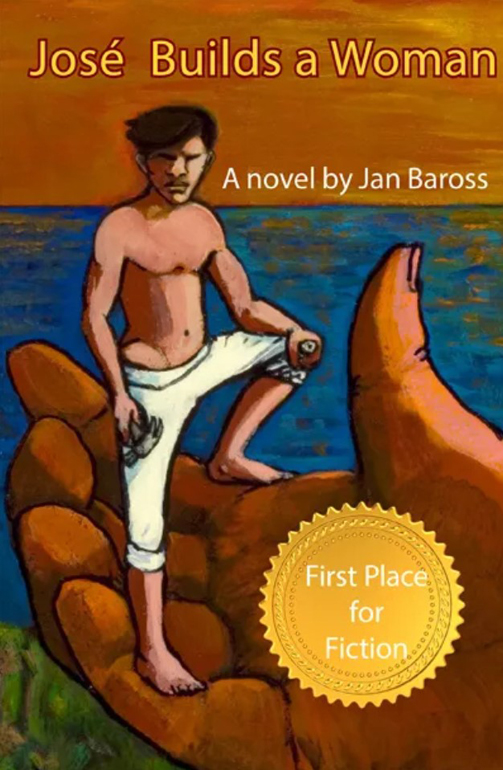
Jan Baross is an award-winning novelist, documentary filmmaker, photographer, screenwriter, librettist, film critic and taught filmmaking at Oregon State University. "Jose Builds a Woman," her debut novel published by Ooligan Press twenty years ago, in 2006, received first place for fiction. Ursula Le Guin gave it a thumbs up.
Baross lives six months a year in Portland, Oregon and SMA where loves designing posters for the Annual San Miguel Playwrights Winter Showcase. Books and Audible on Amazon. Films on YouTube.
www.janbaross.com
**************
*****
Please contribute to Lokkal,
SMA's online collective:
 ***
***
Discover Lokkal: Mission
Visit SMA's Social Network
Contact / Contactar