Grandeza mexicana: The First Significant American Poem
|
|
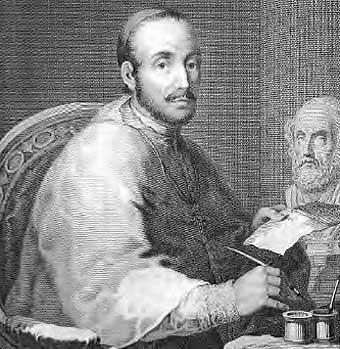
Bernardo de Balbuena
Español
March 8, 2026
by Philip Gambone
In a letter published in El Diario de México on September 14, 1809, an anonymous writer noted that Nueva España had produced more than 4000 writers since the Conquest. The correspondent mentioned with particular admiration the poem Grandeza mexicana (1604) by Bernardo de Balbuena. Today very few people know Balbuena or his magisterial poem. I certainly hadn't until I started teaching myself more about the history of Mexican literature. But for those who do know him, like the great Mexican writer Octavio Paz, Balbuena stands as "one of the most opulent and colorful" poets in the Spanish language.
Balbuena wrote at the height of the baroque era, a European aesthetic movement characterized by exaggeration, convolution, and sensuality. In architecture, painting, music, sculpture, opera, and literature, the baroque artist reveled in flights of fantasy, a wealth of embellishment, inexhaustible movement, and overall complexity. (The music of Bach, the Palace of Versailles, or Bernini's sculpture Saint Teresa in Ecstasy are notable examples.) The eminent Latin American intellectual Pedro Henríquez Ureña considered Balbuena to represent "America's contribution to the magnificent climax of baroque poetry … a profusion of ornament combined with a clear construction of both ideas and images, like the baroque altars in Mexican churches."
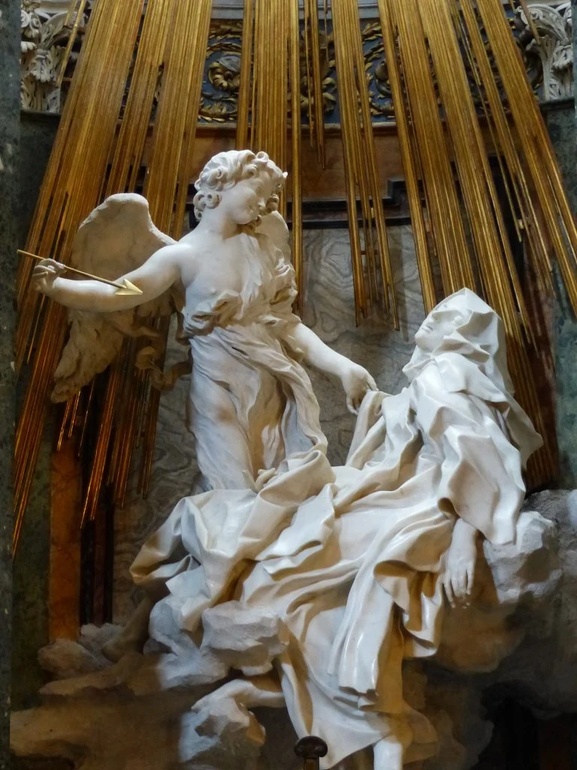
Saint Teresa in Ecstacy by Gian Lorenzo Bernini
*
Who was this Mexican baroque master? Born in Valdepeñas, Spain, in 1562, Balbuena emigrated to the Americas as a boy, pursuing his youthful studies in Mexico City. He subsequently returned to Spain to earn a doctorate in theology. He distinguished himself, writes Roberto González Echevarría in The Cambridge History of Latin American Literature, as a man of "great Christianity, virtue and letters." Balbuena eventually rose to become the first bishop of Puerto Rico, where he died in 1627.
Although he did not spend much time in Mexico, Balbuena fell in love with the country, especially its lush central valley and the magnificent, bustling capital, a city that, by his time, already rivaled some of the great cities in Europe. When Doña Isabel de Tobar y Guzmán, a friend from his youth, asked him to tell her what Mexico City was like, Balbuena cast his answer in the form of the poem, a hymn of praise to Mexico, "describing the famous city of Mexico and its greatness." The result, Grandeza mexicana, stands, Echevarría says, "as the first significant American poem."
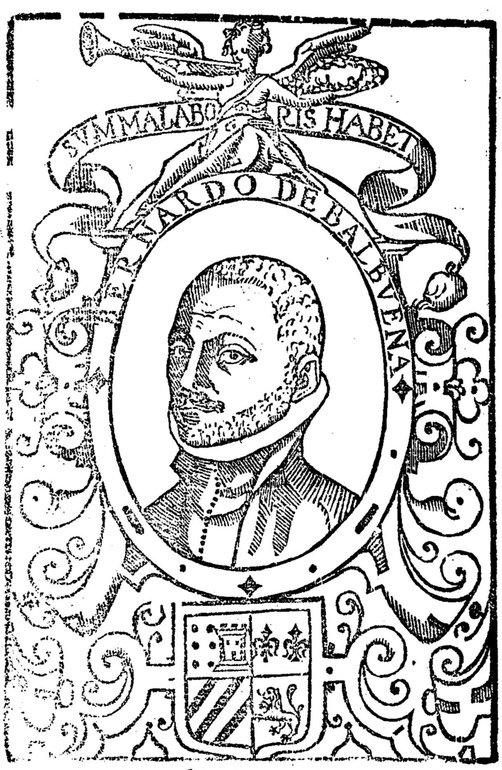
Etching of Balbuena from first edition of Grandeza mexicana
*
Written in three-line stanzas, the poem addresses, among its many themes, the beauty of the land, the grandeur of Mexico's architecture, the city's horses, the cordiality of its citizens, the various arts, and the many celebrations that take place there. The word "grandeza" not only means greatness but also immensity and incommensurateness. In piling up the qualities and products of the various cultures that had collected in Mexico, Balbuena presented a picture of a city, says Echevarría, "beautiful truly beyond description and comprehension … spectacular and made up of disparate, contrasting elements that cause admiration." A baroque poet's dream subject.
Among the most highly praised verses in Grandeza mexicana are those found in Chapter VI, "Primavera inmortal y sus indicios" (Immortal Spring and its Signs), devoted to describing the beauty of Mexico's plant life. In lines that recall a mythical Golden Age, he sings of:
|
|
|
|
the smooth boxwood, heavy, hard, and pure,
the tamarisk beside the crystalline water,
the wild oak, the perfect poplar …
the amorous and tender clover-grass,
the ever restless turnsol or marigold,
the tender jasmine, the crimson gillyflower;
the purple violet, the blue flower-de-luce,
the blithesome garden-balm, the pointed thyme,
the bilberry, fresh myrtle and white musk-rose …
| |
|
|
Nothing about cacti, mesquite and sagebrush here! Similarly, a heroic tone pervades Balbuena's description of the grandeza of Mexico City's
|
|
|
|
houses, streets, horses, knights;
that the whole world cannot equal.
The horses, sprightly, brave, and fierce;
magnificent houses; sumptuous streets;
a thousand horsemen, swift in hand and on foot.
| |
|
|
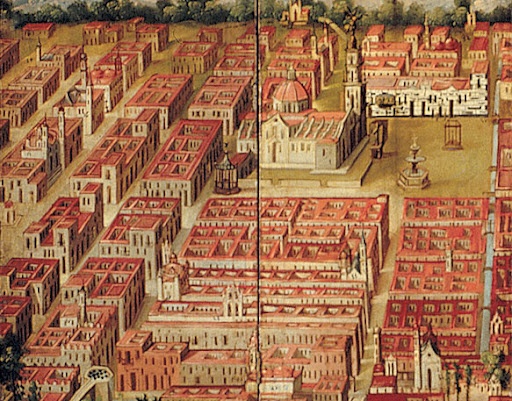
Mexico City (late 16th century)
*
According to Echevarría, Grandeza mexicana was "the first expression of a dominant topic in Latin American literature: the equivalence of all cultures, and the celebration of their commingling in America." For Balbuena, Mexico City was at the center of the world, "not because of tradition or any kind of inherited superiority, but because in Mexico City all the important cultures of the world meet":
|
|
|
|
Mexico divides the world in equal parts,
the earth bows to it as if to a sun,
and it seems to rule over the whole orb.
It [Mexico] trades and corresponds with all of them,
and its stores, warehouses, and cellars
hold the best that all those worlds can offer.
| |
|
|
As the gathering place of culture, Mexico City became, literally, "the world's emporium," writes Rolena Adorno, professor of Spanish colonial literature at Yale. Balbuena's poem celebrates and enumerates the city's mercantile richness. Indeed, Balbuena's love of lists has led some to call the poem a "catalogue in verse":
|
|
|
|
Peruvian silver and Chilean gold
wind up here, as do, from Terrenate,
fine cloves and Tidorean cinnamon.
From Cambray come fabrics, wealth from Quinsay
coral from Sicily, from Syria aromatic narc
incense from Arabia, and garnet from Ormuz;
diamonds from India, and from the noble
Scythia rubies and fine emeralds,
from Goa ivory, from Siam dark ebony;
in short, the best from the whole world,
the pick of all that's known and practiced
swarms here, to be sold and bartered.
| |
|
|
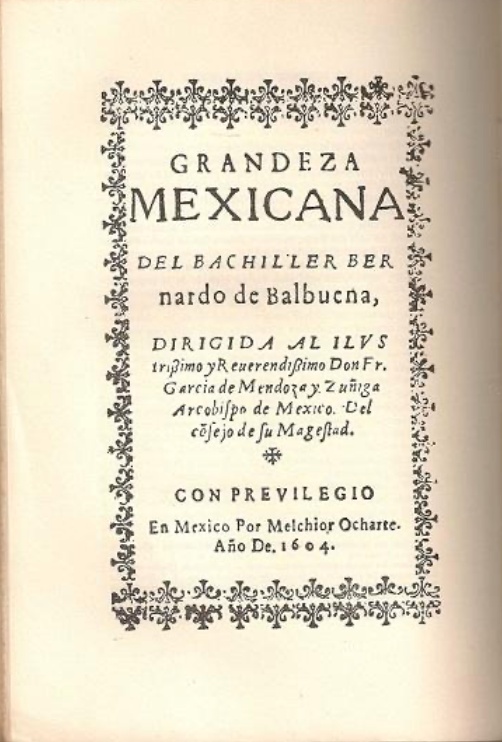
Grandeza mexicana (1st ed., 1604)
*
One does not seek realism in Balbuena's description of Mexico, notes Irving Leonard in his lovely book Baroque Times in Old Mexico. "He had no eyes—or nostrils—for the unpoetic reality of the often sluggish, stagnant, and nauseous waterways, whose murky shallows were befouled by corpses of animals—and sometimes of human beings—excrement, and the varied refuse of a congested city."
The poem ends with praise for the mother country, Spain, its wealth and power:
|
|
|
|
May the world you govern and authorize
praise you, sweet homeland! And to your shores
may either my humble body or its ashes return.
| |
|
|
In recent years, Balbuena's vision of Mexico as an Arcadian paradise has come under criticism by Marxist scholars like Hernán Vidal, who calls the work "the most conspicuous imperialist poem of the colonial period." Vidal points out that Balbuena only mentions a native American once, calling him "el indio feo," the ugly Indian. Moreover, his claim that the Spanish Empire is the rightful successor of the Incan Empire, legitimizes the brutality and fraudulence of the colonial enterprise.
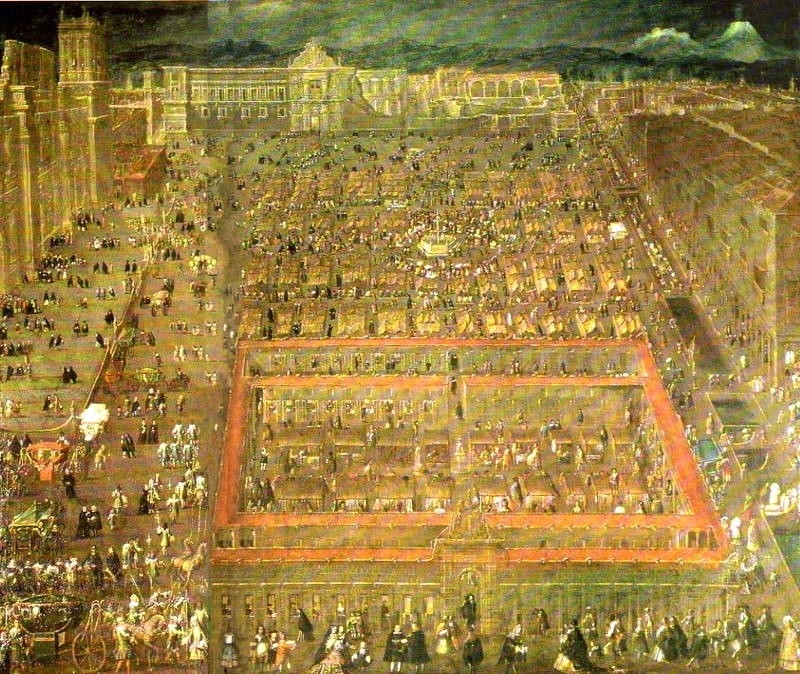
Mexico City (17th century)
*
These are legitimate criticisms, and should be taken seriously. Still, I think there is a way to read Grandeza mexicana that both acknowledges its political and ideological difficulties and at the same time allows us to enjoy the richness of its deliciously exaggerated language and vision. Without a doubt, the poem is a masterpiece of baroque style, full of "brilliance, color, and erudition," as Julio Torre writes in La literatura española.
It's unfortunate that Balbuena's poem, in its entirety, has not received an excellent translation into English. And while I cannot claim to read the poem without the help of a dictionary and Google translate nearby, nevertheless this "swift and sumptuous game," as Octavio Paz called the extravagant work, is well worth looking into. If, like me, you're a fan of baroque art, then Grandeza mexicana may just be your cup of hot chocolate.
 **************

Philip Gambone, a retired high school English teacher, also taught creative and expository writing at Harvard for twenty-eight years. For over a decade, his book reviews appeared regularly in The New York Times. Phil is the author of seven books. His memoir, As Far As I Can Tell: Finding My Father in World War II, was named one of the Best Books of 2020 by the Boston Globe. His new collection of short stories, Zigzag, was published last year by Rattling Good Yarns Press. His books are available through Amazon and at "Tesoros," the bookshop at the Biblioteca.
**************
*****
Please contribute to Lokkal,
SMA's online collective:
 ***
***
Discover Lokkal: Mission
Visit SMA's Social Network
Contact / Contactar

|
|
|
|
| | |
Click ads
Contact / Contactar
copyright 2026
|