 Español
June 14, 2026
Previous chapters
by Jan Baross
CHAPTER TWENTY-TWO
Above me the dark pouches of Miguel's face quiver with almost sixteen years of disappointment. His matted loins pump up and down between my legs in the morning's ritual thrust for sons.
"Give me sons, give me sons," chants Miguel.
Trembling hair halos his head. He drops enough tears on the furrows of my flannel nightgown to sprout all those unborn carpenters. Finally, with a sigh and a dribble, Angelicus Maximus once again releases his little fish inside me. Miguel rolls off my body praying still louder.
"Give me sons. Give me sons."
His rage for heirs is worn in our sheets. He sits up and spits away evil spirits around the bed that he is certain are making me barren.
"This time I have gotten you pregnant! I know it!"
He wipes his eyes with a balled fist and blows his nose on the sheet.
"At least we have José," I say.
Miguel drops back into the sheets and closes his eyes. He drools now when he sleeps. His lips move in his dreams that never bring peace in sixteen years of such effort. Only when he eases into the darkest slumber do the woodcut lines of anger disappear.
I slide to the edge of the bed. My naked thighs are wet with the unborn. I plug my feet into worn sandals that take me to my own morning ritual.
The only thing beautiful left in me after all these years is my black hair, which swings in a long braid. My overbite has gathered wrinkles. My laugh lines are frowns. But I still have my sweet dreams of Gabito, and when Gabito is angry with me, I dream of Señor Domingo Peres and his dark Indian face full of our unlived love.
Squatting on the damp tiles of the veranda, I loosen a brick in the wall and pull out a bottle of vinegar and a small sea sponge wrapped in a bag. I soak the sponge with vinegar, hold my breath, and shove it inside me.
"Do not give me sons. Do not give me sons."
At the first rush of vinegar, Miguel's small army of carpenters drop their tools and die. It is easier to think of them as faceless battalions rather than potential sons. If it were not for Fecunda's vinegar remedy, eleven sons would have buried me by now. The lining of my woman's mound is sore, raw, and burnt from the years of genocide. A smear of aloe spreads enough cool jelly to lighten the pain.
Under the shower pipe on the veranda, sun-warmed water dilutes my acrid scent. I blot myself dry and watch the fishermen's white-winged boats sail onto the sand with their catch. Señor Domingo is always the first to leap off his boat. I will buy one of his fresh fish and cook it for José's birthday.
Quietly, so as not to wake Miguel, I dress in what has become my uniform: white blouse, blue skirt. My sandals are better trained than puppies. They know the way to José's room.
José does not like me watching him sleep. But today he is sixteen, and this is the only time to count the years on his face.
The light in his room filters through a small window above the bed. On the sill is his first Madonna carving that showed his promise. The face belongs to the skinny neighbor girl, Pilar. No one in the village is quite as plain or mean as Pilar, and yet José has loved her since they shared Fecunda's breasts as infants.
Hooks on the wall hold his few clothes. There are no pictures, only a small black-and-white poster of a traveling show. José's carpenter tools lie in a box at the foot of his bed. Over his bed is his carved pine plaque with block letters in the old style: "To touch heaven with my work."
It is a well-kept room, for a boy. The eleven smaller beds of unborn sons are stacked to the ceiling in one corner. My husband keeps his dream in an inconvenient pile. José lies on his side. Curly black hair spreads across his pillow. He is hugging his own honey-brown shoulder.
I kneel by his bed to worship my son's adolescent face. Under long dark lashes, José's eyes rush back and forth following a dream. He smiles, moans, presses his hands down below the sheets. This is the time I should leave, but I do not.
I enter his dream just in time to see Pilar, who has taken on the proportions of a voluptuary, lower her soft green robe below a rosy bottom. Her dark eyes look at José. Together, she and he breathe in a duet of flushed skin. I leave his dream as quickly as I enter and pull the sheets up over his shoulders. The church bells ring loudly enough to open José's eyes.
"Happy birthday, José," I whisper. "Do I need to remind you that Pilar was born a nun? It is not coquetry that she ignores you. It is blind indifference to anyone but Jesus."
José squints sleepy eyes at me.
"Please stay out of my dreams, Mamá."
I kiss the swell of his brown cheek.
"Sleep as late as you wish. Your father will not make you work today."
In my kitchen the day begins, as it does every day in this bruise-colored house. Roosters crow up and down the winding streets, answered by the street-sweeper's song and the steady foot-patter of children running for morning tortillas.
Little Salvador tosses me a paper-wrapped package of hot tortillas through the kitchen window. I lean out and drop coins into his hands. He gives me a quick smile because I always add an extra coin.
Five tortillas for Miguel, five for José, three for me, flat in the hot pan with a layer of sliced tomatoes, melted chunks of soft cheese on top, cilantro and peppers, and a big cup of coffee with sugar.
José's appetites are free to roam today. He will not return home with wood chips in his hair. Even when I give him enough coins for the whore Esmeralda who lives at the edge of the village, he'll spend his day spying on Pilar. My poor son will die a virgin if he saves himself for that pure vessel.
Gabito leaps from the water bucket like an acrobat and smooths his navy uniform. Unlike the rest of us, nothing changes with Gabito. He is always the same half-beautiful man. I no longer see his fault lines.
"Ready for José's sixteenth birthday?" I say.
Gabito's eyes overflow with excitement. We have become such good friends that we tolerate each other's nonsense. He ignores my marriage to Miguel, though true to his word, he will not give me the snails back. Since there is time enough in my dull life, I can comply with the demands of a second husband. It is a small consolation for Gabito that there is no pleasure for me in Miguel's pumping ritual. Gabito can see from my face that I barely tolerate my wifely duties.
"Today our son is sixteen," says Gabito.
I promised him that on José's sixteenth birthday, we would tell him Gabito is his father, but I am afraid of what will happen.
"Do you still want to appear to José and tell him who you are?" I say.
Gabito adjusts his damp wool jacket and turns so that I can see only his bad side.
"Look at me, Tortugina," says Gabito. "I am in shreds. The boy not only has a dead man for a father, but there are no fathers uglier than me. Think how disappointed he will be when my . . ."
Gabito replaces his weeping eye in his socket. It has been a long time since I noticed Gabito's leaking face, the thin membrane that protects his heart, his lips that curve in an unnatural smile.
"You see, I cannot control anything. He will hate me. I just cannot do it."
What he really means is he has not finished mourning his perfect beauty. But I am so deeply relieved that I speak out loud to Gabito as though we were husband and wife in the real world.
"Then we won't tell him," I say. "It will be for the best. José might tell Miguel. And this is what will happen to me if Miguel Svendik finds out José is not his son."
I slap the table as though killing a bug. Gabito jumps and we laugh.
"You see," I say. "He even frightens you."
Pipe smoke from Magdalene drifts into the kitchen. I turn quickly to see Miguel's bull shoulders filling the doorway. He is barefoot, and smoke pours out of his nostrils.
"José is not my son! Is that what you said?"
The only time I spoke out loud to Gabito in my house, and Miguel was there to hear me. My fingers tighten on the cup.
"What is wrong with you?" I say. "Of course he is your son. I was joking with God. We are like that together."
Billows of Magdalene fill the room. Miguel seems to be on fire.
"Tell me the truth!"
"Tell him the truth, Tortugina," Gabito says to me.
I try to drink my coffee, but Miguel knocks the cup out of my hand.
"Tell me!" he yells.
"You know you were first," I say. "You saw my virgin blood."
Miguel's lips turn white. "There are women's tricks!"
All our years of no babies are rushing toward me.
"José looks nothing like me," says Miguel.
It is true. Thank God. José looks exactly like Gabito, except for the destruction. Gabito snorts from his superior position on the ceiling. I hear my voice losing conviction.
"He has your skill with wood," I say.
A weak, embarrassing lie. José is far better than Miguel. I move so the table is between us. Miguel trembles like an earthquake, and our wall of illusions crumbles. For once we look into the deceit that is our lives.
With a brutal cry, he lifts the table up over his head, the legs pointing at the ceiling. He straightens his arms, and the table legs plow four holes into the sky-blue stucco that falls around us in pieces. Miguel throws the table at the window, and the glass shatters.
"Who is José's father?" yells Miguel. "Tell me the truth!"
His brows are thick as thorns.
"You, you are his father!"
Miguel grabs my braid and jerks me off my feet. He twists the braid around his hand. My roots are screaming. He drags me over the wood floor, over the threshold, into the backyard. The red dust billows up my skirt. At the woodpile he grabs the newly sharpened hatchet. My heart is a wild caged thing. I kick at him and scream, "Help!"
He pushes my head down on the wood block. The grooves gouge my cheek.
"Tell me who the father is!" he shouts.
The heel of his hand, the full weight of him is on the side of my head. My eyes are watering. He raises the hatchet. I want to tell him the truth, though the words cling to the back of my throat.
"Tell the bastard, Tortugina!" yells Gabito.
"José was fathered by a ghost. Gabito. I killed him by mistake. It is you, Miguel. You are the only father he knows!"
Miguel's hand pushes harder on the side of my head. If I were a melon I would have burst by now.
"José is not my son," he says. "No son of my loins walks this earth!"
He raises the hatchet over his head. "What have you done to me, you whore!"
The hatchet blade slices toward my neck. I twist away and feel hands grab my hips and jerk me back from the chopping block. Not fast enough. The blade slices through my braid and the skin on the back of my head. Warm blood flows down my neck, over my shoulders. The wound is a dull ache, a terrifying run of liquid. I am shaking too badly to run, but I crawl behind Gabito.
Miguel kicks my bloodied braid off the chopping block and wedges the blade out of the wood. Raising the hatchet again, Miguel steps straight through Gabito to me.
"Whore!" yells Miguel.
José runs into the yard toward me with a bath towel around his waist.
"Papá!" screams José. "What are you doing?"
José kneels beside me, strips the towel off his body, and holds the cloth against the back of my head. Poor José has known Miguel's temper all his life, but this is the worst he has ever seen.
Miguel stands over us breathing hard. He spits at us, turns, and throws his blade into the trunk of the banyan tree. I feel the force in my skull.
"Papá, my tree!" yells José.
At the base of this tree, sixteen years ago, Miguel planted José's placenta.
"Tortugina! You see what you made me do!" screams Miguel.
He stumbles across the yard toward Fecunda's house.
"Help!" screams José. "Someone help!"
*
CHAPTER TWENTY-THREE
Behind our closed shutters, Señor Domingo uses black fisherman's thread to stitch the cut on the back of my head. The smell of fish on his bloody hands turns my stomach. José's job is to blot the trickle of blood and lay slices of aloe on the wound. My job is to drink myself painless.
We are all drinking, a very good bottle of old red wine that Miguel left behind, saved from his mother's time. After all, we are celebrating José's sixteenth birthday. It is a special wine, a special day, and a special bloodletting. So far, neither has asked what the fight was about.
"José," I say, "I am sorry this has turned out to be such a bad day for your birthday."
Gabito rages and, pacing the kitchen, swings his short naval sword in the air.
"Bastard!" he says.
José pours us all another glass of red wine in my mismatched glasses.
"Ah, well, Mamá," he sighs. "You are alive, at least. And sixteen is such a sad year, anyway."
Domingo ties the bandage around my head just tight enough.
"Why do you say that it is sad, José?" asks Señor Domingo.
José drinks half his glass before he answers.
"I am at the age to marry. I want to marry Pilar, but she ignores me. She will not come to my house, and not once has she thanked me for my gifts."
"I thought everyone knew she intends to be a nun," says Señor Domingo. "With her limited nature, she is well suited."
"You will find another girl," I say.
"NEVER!" says José.
José finishes his glass. This is a strange day, without solutions.
Miguel's voice and the smell of his pipe float across the path from Fecunda's. Señor Domingo's sad eyes are weighted as a hound's. He is having as hard a time as I am trying to ignore them. Even if I close the shutters tight, there is always enough space between the slats to hear their laughter.
José hands me a yellow scarf, and I cover my bandage. The balm of superior wine does not erase the pain completely. José fills our glasses again and we raise them.
"Happy birthday, José," I say. "We still have our tradition. Open my present."
He opens the soft brown tissue tied with dried grasses. It is the same every year. I have no imagination for such things. I left a little sentiment under the grass bow. José slides it out and reads aloud.
"Tonight is the sixteenth year you have been my son. I have loved you all your life with all my heart. Love, Mamá."
José unwraps the shirt I sewed so carefully. It is soft white with glowing silver threads of embroidered turtles. He takes off his old shirt and stretches into the new one. The white against his golden skin stops my breath. I made this shirt, this beauty, and this boy. He kisses my cheek. There is the soft start of a moustache above his thick red lips.
"Another shirt. Thank you, Mamá," he says.
"It is beautiful workmanship," says Señor Domingo.
José brings me a long, newspaper-wrapped object. It was his idea to give me a gift on each of his birthdays.
"I made this for you," he says. "Sorry, Señor Domingo, I did not know you would be sharing my birthday, so I have no gift for you."
Señor Domingo nods. "I am honored that you allow me to join you."
José has carved me another Virgin. Virgins line my shelves. His first baby-made statue was a block of soft balsa with grooves and bumps that matched the ups and downs of my life. As he grew, his Virgins assumed my face, chiseled with my hollowed overbite and sad edges. He became skilled under Miguel's careful teaching, and his Virgins grew thinner as I grew thinner, with arms open to encompass small hopes. That is when I began to look as I do now. Even in soft candlelight, this Madonna looks like a woman who has given up on prayers. Her face is true to my darkest moments. His Virgins are my mirror. But there is only so much reflected truth one can take at this stage of life.
"Do I really look that bad, José?" I say.
My fingers move lightly over the statue's face.
"Bad? No, Mamá. Just you. Should I have lied with my art?"
I pat his cheek. "Yes."
"I will make her younger," he says.
"Next year," I say.
Señor Domingo turns the statue in his strong hands.
"José, you are a finer carver than your father. I would like to hire you to make me a figurehead for my boat. That is your birthday present."
I have never seen José so dazzled since he reached puberty.
"Señor Domingo, this is the best gift you could give me. I have always wanted to carve bigger. Thank you. You will have a figurehead that will be talked about in every village!"
Gabito has sheathed his sword, and his transparent fingers stroke the fine folds of the Madonna's robe.
"Our son made this beautiful thing, Tortugina," he says.
He stands behind José proudly. Their brown eyes are so alike, each pulling at my heart from his own world.
A quiet knock on the kitchen door interrupts us.
"Papá?" whispers José.
We do not know anyone with such a courteous knock.
"Who is it?" I say.
José's chair squeaks as he gets up and walks through Gabito to the door. Gabito touches himself where his son passed through him, tears welling in his eyes. He floats to the kitchen counter and sits, bewildered by the two sides of himself, love of his son, fear that José will hate him.
José takes a stumbling step backward from the open door. He is having trouble breathing.
Pilar stands in the doorway with the morning sun behind her. A white collar surrounds her bony face.
"Pilar," whispers José.
Pilar's flat black eyes peck around the room and settle on Señor Domingo. She steps inside and delivers her commandment.
"Father, Mother said to come home." Her razor voice could geld a ram.
Señor Domingo is no longer smiling. "My daughter, Pilar. She herds our family like sheep."
José puts his trembling hands in his pockets. "Pilar, what an honor. Please sit. It is my birthday."
Pilar's eyes are fixed on her father and her mission. "Father, come home."
"Pilar," says Señor Domingo, "where are your manners? Sit down and wait until I have finished my business in this house."
Pilar's eyes kick from side to side like flames caught in a breeze. Her black nun shoes do not move. Poor José's legs are trembling beneath his pants.
"Please sit just for a moment, Pilar," says José. "It would honor me."
Pilar may as well be watching José from behind thick cloistered walls. As he moves, his foot catches on the chair leg and he trips. He catches himself and pretends he meant to pull the chair out for her. His eyes draw upon what little beauty she has to nourish him.
"I am going to tell Mother you refuse to come." Pilar turns to the door.
"No, wait, Pilar!" says José. "Wait! Talk to me!"
Pilar disappears out the door into the morning breeze, and José runs after her.
"I love you. I have always loved you!" he yells.
Gabito dives through the door after José. I am left sitting beside Señor Domingo. We watch the late morning haze outside my kitchen door.
"I apologize for my daughter," he says. "Perhaps I should go."
Because we are alone, I look at Señor Domingo in a new way.
"Stay," I say. "You have saved us from a very sad day."
"It is you who saved me, but then, all my days are sad."
These words from a man who never complains. It must be the Italian wine, so full of sentiment. I know why he is sad, but I pretend I do not know.
"Why are you sad? You are the finest fisherman in the village, and all your children are healthy."
"Those are my blessings," says Domingo. "But I am weak. I allow Miguel to come every night to my house and drink with my wife because it pleases her. He pretends my children are his. Today I was going to kill Miguel. It was José's cry for help that saved me from a murder."
I tug at my scarf.
"Then my mutilation has worked well for everyone."
He sees the humor in my eyes. I want to put my hand on his lined face, to feel the skin of this man, but I do not.
"You are a man of great patience and restraint, Señor Domingo."
Señor Domingo's eyes are tender.
"Please, after so many years," he says, "call me Domingo."
He bends forward slightly to encourage me. I whisper the sweet informality.
"Domingo," I say.
When I inhale, I do not breathe air. I breathe him. His smell of fresh fish is growing more like sex. I whisper again.
"Domingo."
His fingers brush my hand. It is a relief to be touched by a man who is not my husband.
"Since the first day Miguel brought you home on the camel," says Domingo, "I have always wanted to tell you, we share so much more than our mutual suffering."
It is almost painful to move my hand away from him.
"I am sorry, Domingo," I say. "My concern is for my son."
"Mamá?"
José is framed in the door like a carving from the Hell side of the church door. His face is red. His eye is swollen shut. His hair looks like someone tried to pull it out by the roots.
"It did not go well with Pilar?" I say.
"It is a beginning," he says, looking back and forth between Domingo and me.
"Is Señor Domingo my father?" says José.
I cough up my wine. Domingo laughs.
Gabito floats through the door and stands shoulder to shoulder with his son. Both have one good eye now, and their good eyes are raging at me.
"Tortugina," says Gabito, "my son thinks this man is his father!"
I can only ignore Gabito when he is like this.
"You know who your father is," I say. "Why do you ask, José?"
Señor Domingo smiles. "If you were my son, José, I would be proud to tell you."
"Señor Domingo," says José, "you look at Mamá the way a man looks at his beloved."
"I do care for your mother," says Señor Domingo.
Gabito bellows like a bull stuck by the picadors, one sharp wound to ignite his temper.
"And I do not look like Papá," says José.
"I hate to disappoint you on your birthday, José," I say. "But there is no man alive who is more your father than Miguel."
The candles flicker as Gabito bats himself angrily around the room.
"What do you want me to say, Gabito!" I say only to him.
José smiles. "Then Pilar is not my sister?"
Señor Domingo laughs again and shakes his head. "No, José."
José picks up a half-bottle of wine.
"My birthday wish has come true. Pilar came to my house. I am going to my room to drink and dream of our wedding."
Gabito spins in his own confusion until even the hanging garlic begins to move in the breeze. "Tortugina! I want to tell José he is mine! I have to tell him! I do not know what to do!"
Gabito's grief is too big for my kitchen. He flies out the open door with the most terrifying scream I have ever heard.
I am afraid he will return. I am afraid he may never return.
Domingo and I part chaste. He and Miguel Svendik pass each other at my door, each man seeking the bed of his wife to snore off the liquor.
Read more chapters
**************
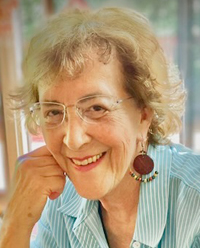
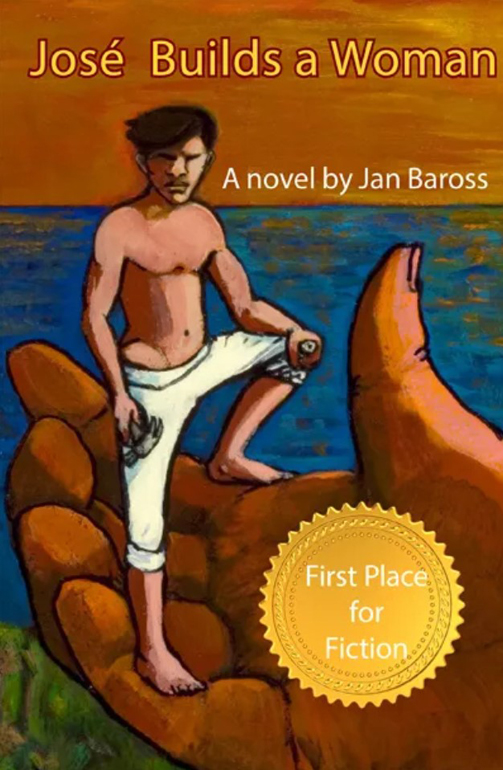
Jan Baross is an award-winning novelist, documentary filmmaker, photographer, screenwriter, librettist, film critic and taught filmmaking at Oregon State University. "Jose Builds a Woman," her debut novel published by Ooligan Press twenty years ago, in 2006, received first place for fiction. Ursula Le Guin gave it a thumbs up.
Baross lives six months a year in Portland, Oregon and SMA where loves designing posters for the Annual San Miguel Playwrights Winter Showcase. Books and Audible on Amazon. Films on YouTube.
www.janbaross.com
**************
*****
Please contribute to Lokkal,
SMA's online collective:
 ***
***
Discover Lokkal: Mission

Visit SMA's Social Network
Contact / Contactar