 Español
January 4, 2026
by Dr. David Fialkoff, Editor / Publisher
I have never been so busy for so long, nor so pleasantly, as I was last week.
I go to New Orleans twice a year to visit my daughter, but last week was the first time she's come down to San Miguel to visit me... and to get a wisdom tooth (with a long, curved root near a nerve) pulled.
Fifteen years ago, my life in Connecticut was coming to an end. You've heard that joke: What do you get when you play a country music song backwards? You get back your dog. You get back your truck. You get back your girl.
The last straws for me were when the beautiful, young, talented, over-sensitive violinist I had been dating for seven years, lost her mother and decided to move to California; and then when I lost my mother and decided to not move to California, having been there and done that.
That year, 2011, I moved instead to San Miguel, where my daughter, S. had already been living for two years. My first years here I was widely known as "El papa de S." When, two years after my arrival, S. moved to New Orleans I became known for other reasons.
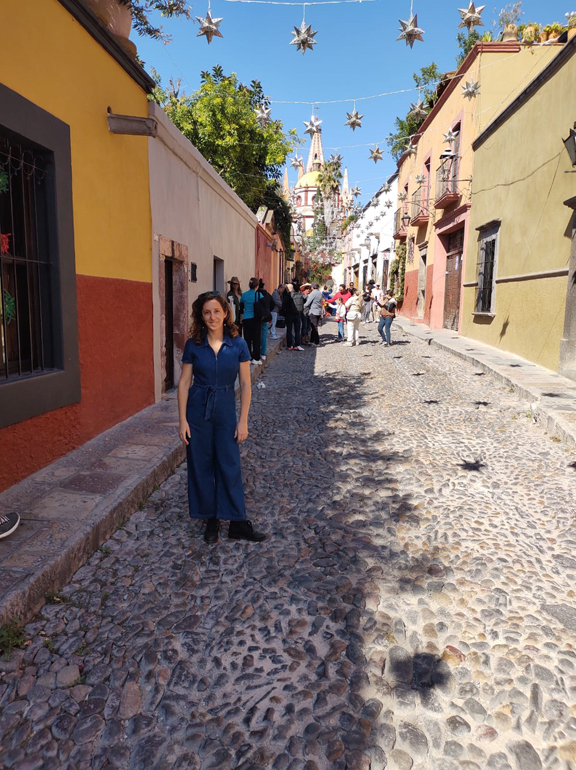
When I visit New Orleans, we take it easy, going out a few times, usually for dinner or music. But last week, S. arrived late Christmas day, eager to shop, to travel down memory lane and to see the changes that had taken place in the dozen years she was away.
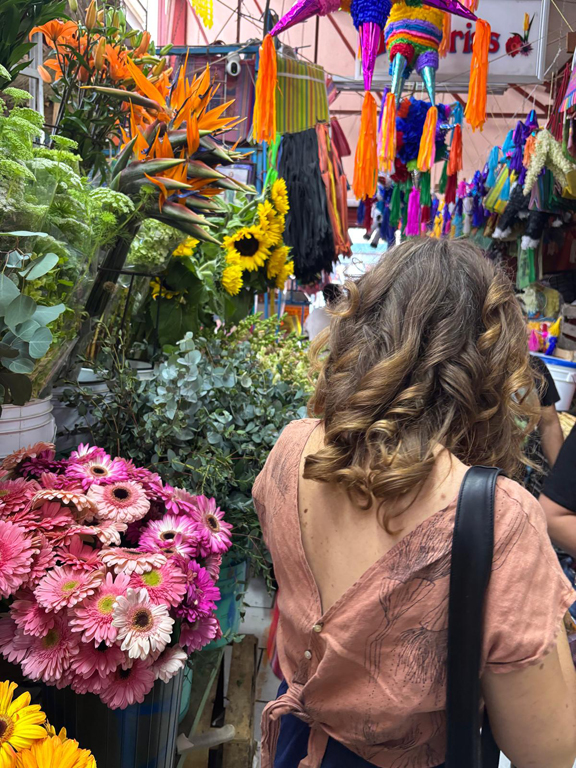
So, the next morning, Friday, we parked my old gray VW Crossfox on Calzada de la Luz with the intention of walking up through the artisans' market. Right there where the alley begins (or ends, depending on your perspective), while S. browsed, I struck up a conversation with a somewhat crumpled American waiting in the shade while his wife browsed. Two minutes later S. returned and greeted the man, and his wife, who had meanwhile returned, like she knew them, which in fact she did. They had been her shuttle companions on the ride in from the airport in León the evening before. It was a very strange coincidence, especially as I don't make a habit of interacting with unknown, somewhat crumpled Americans.
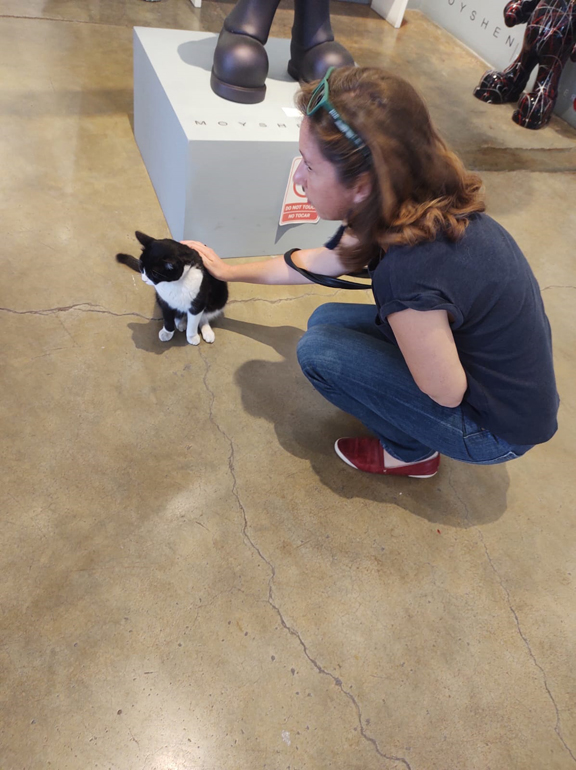
Bidding them goodbye, we walked up through the alley, not yet buying, only considering options, like the smart shopper that S is. I won't give you the blow by blow of the rest of the day, but it included a long stroll through el Centro with a late lunch at Don Taco Tequila's. That evening, after celebrating the Jewish Sabbath, I drove S. into town to visit with friends.
Saturday, we started at Buonforno, picking up a loaf of rye bread and a slice of their nut pie. S., who is an avid baker (she brought me down a large bag of chocolatey cookies) is of the opinion that it's hard to find good pastries in Mexico. But the nut pie was a hit. Then we parked and walked to the Saturday market, which was all new to her.
After buying our vegetables and fruit, we sat down and listened to Lencho (guitar) and Carmie (mandolin) perform their weekly set of Americana. Soon after, I called over Robert C. and introduced him and S., ending that presentation with the question, "Robert, what was it you did in Washington?"
Robert, who reads my articles each week, where S. and New Orleans not infrequently appear, lit right up and launched into his personal history, about which when I've asked before he has been reticent. This time he was positively forthcoming, volunteering that he was Chief of Operations (including security and protocol) for the Congress of the United States (being one of the first to be aware of breaking issues) for 24 years. Also, confessing his love for New Orleans, he revealed that he had attended every one of the first 36 New Orleans Jazz Fests. Again, I'm not going to share here everything he said (I'm trying to persuade him to write articles for us), but it was all very entertaining and impressive.
Then, while S. and I were eating a very Mexican brunch, Carmi sat down with his mandolin and, with a little encouragement from me, started sharing bits and pieces of his life up in Santa Monica back in the day: including that Bob Dylan owns a synagogue there; that Joni Mitchell played a dulcimer he made on her Blue album; and photos on his phone of the clothes of Nudie, the immigrant Jewish-Hungarian who, with his outrageous showy outfits, became the tailor to the stars.
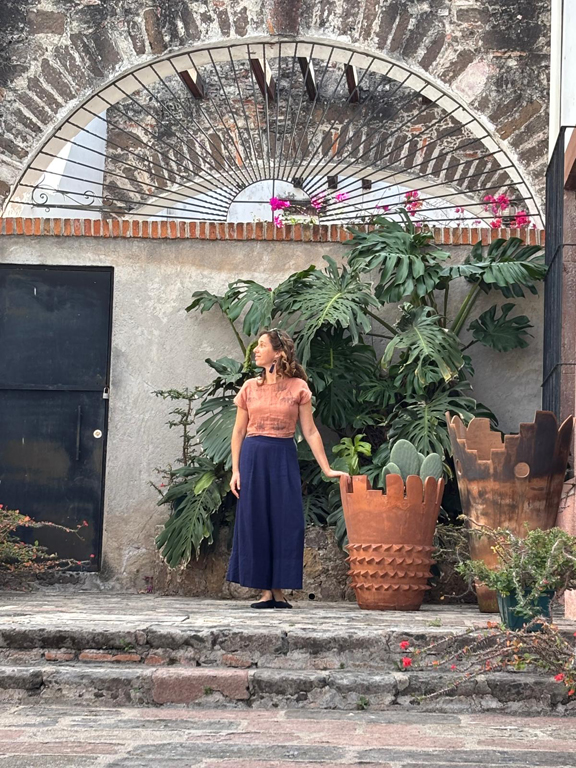
Then, the artist John Schooler came over with his daughter, who was also visiting from New Orleans, who also works for Tulane, and we talked while our daughters got acquainted, realizing their friends in common.
Immediately after that, leaving the market, we bumped into Bea Aaronson, whose grandmother, I recalled then and there, was in the avant garde circle in Paris along with Picasso and Gertrude Stein. Then we strolled down the Ancha shopping (including visits to two holiday craft fairs, both at the Instituto Allende), bumping into people I knew along the way: "Let me introduce my daughter..."
It was a whirlwind of creative people and things. S. was enjoying herself, reviving her excellent Spanish, reliving memories and taking things in for the first time. I was nothing short of ecstatic.
We took a right off Zacateros, walked up Pila Seca, down Aldama, through Parque Juarez, and into colonia Guardiana, where we had parked, then drove to the market, picked up our bags of produce and went to lunch at Rustica. Then, we drove home to San Luis Rey. There S. changed her clothes, and after driving her back into town, where she was meeting friends at 7:00, I went back home, and got to work publishing my Sunday newsletter.
On Sunday something happened that almost occurred terribly. After another short stroll through el Centro, early in the afternoon we drove up the hill to the tianguis at the plazita, the Tuesday market, which also occurs on Sunday. Mexicans liking their music loud, it was a sensory overload. Rather quickly, we left and driving towards Jalpa made our way to the hillside home restaurant, Lagunillas. Again, I'm leaving out a lot of curious details (they were happy to see me after years), but it was very tasty and authentic. Now, for the almost terrible part.
We drove down the long, deserted country road from Lagunillas as the sun was setting, and made it out along the long road from Jalpa onto the road that goes to Querétaro as dusk was coming on. Everything was fine until I tried to accelerate out of the rotary in front of the municipal offices and realized that the car had stalled. The car, refusing to restart, had just enough momentum to roll past the traffic cop standing on the edge of the rotary and come to rest in a parking space in a parking lot in front of another municipal building. By then it was already dark.
Again leaving out a lot of details, the traffic cop, after listening to the car, agreed with my assessment that it wasn't getting gas, suggested that the gas pump had failed, and told us that it would be perfectly fine to leave it where it was overnight. Right on the road out front, five minutes later, S. got on the #9 bus into el Centro where she was to meet a friend, and I waited another 15 minutes for the #3 bus to San Luis Rey.
The potentially terrible occurrence would have been if the gas pump had decided to quit on the long, deserted road down from Lagunillas where we didn't even have phone service. Even if it had failed any lesser distance before the rotary in front of the municipal offices, it would have been very unpleasant as the buses into town don't run that way, at least not at night.
The next morning, Monday, I called my mechanic, Mario, arranging to ride over with him to my car that afternoon, then Ubered to the dentist with S. The extraction went as well as could be expected for a process that required over an hour of wiggling and pulling with pliers. Back at my house, S. was very brave, managing the pain with Ibuprofen and homeopathic Arnica. She was traumatized, but had what she needed. I bicycled over to my mechanic's.
Arriving at the car, Mario listened as had the traffic cop. Coming to the same conclusion, he gave three slaps to the bottom of the gas tank, reawakening the gas pump, and the car started right up. Why he didn't tell me to slap the bottom of the gas tank when I called him the night before is another question, but, the car running, he told me to drive home and drop it off at his shop the next morning.
This S. and I did, and spent the rest of Tuesday and Wednesday, when S. wasn't visiting with friends, exploring San Miguel aided by Mario having the car fixed in less than 24 hours. We had planned on my driving her to the airport, but, chastened by our nearly terrible experience, the shuttle came to pick her up at 11:30 Thursday, New Year's morning.
It was nice to finally use the bus into town. Now, when I want neither to drive nor bicycle, I won't be as likely to stay home. It was good to see the city through a new pair of eyes. It was great to have someone to love and care for.
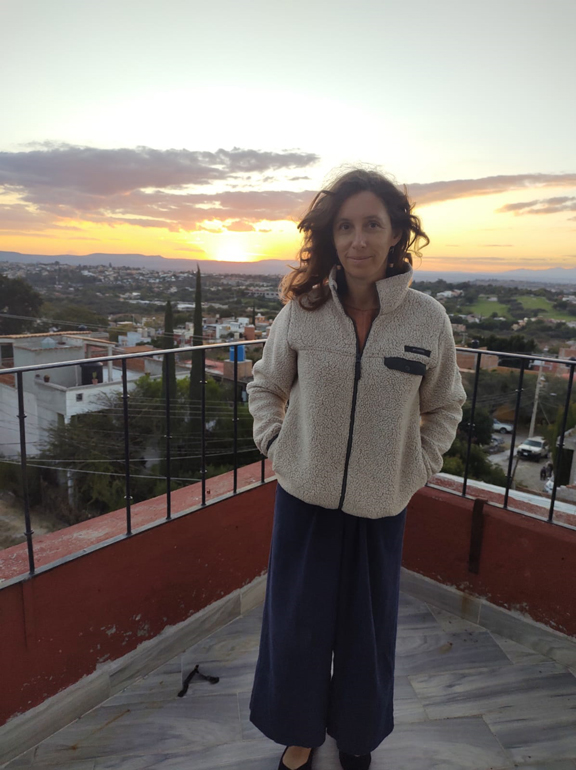
S. brought down a volume of Jorge Luis Borges, his Collected Short Stories, which she has been reading with a friend. We read "The Circular Ruins," which I had referenced in one of my recent articles. Borges' recurrent themes include mirrors, labyrinths and doubles. In his story "The Other" Borges writes about meeting his younger self sitting on a bench.
The younger Borges is sitting on a bench in Geneva, by the Rhône River, in 1918, where Borges spent formative years during World War I. The older Borges is sitting on a bench in Cambridge, Massachusetts, by the Charles River, in 1969.
One of the most haunting elements of the story is that the older Borges desperately wants the younger one to recognize him, to feel the continuity of identity, but the younger Borges remains skeptical, distant, almost polite. The older realizes, painfully, that the meeting cannot be mutual in the way he hopes: "The only asymmetry is that the younger man will remember having met an old man, while the old man knows that the meeting will dissolve into doubt and memory."
S. and I are two peas in a pod, alike physically as well as mentally and emotionally. I, the older and she, the younger, we achieve the merging of identity that eluded the doubled Borges. Her visit was like being visited by a younger, albeit more feminine, version of myself. Borges could not speak across time to himself, but I have.
**************
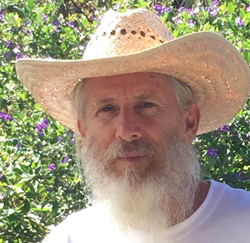
Dr. David Fialkoff presents Lokkal, public internet, building community, strengthening the local economy. If you can, please do contribute content, or your hard-earned cash, to support Lokkal, SMA's Voice. Use the orange, Paypal donate button below. Thank you.
**************
*****
Please contribute to Lokkal,
SMA's online collective:
 ***
***
Discover Lokkal: Mission
Visit SMA's Social Network
Contact / Contactar