 Español
December 28, 2025
by Philip Gambone
When I was growing up, my family always brought a poinsettia into our home during the Christmas season. No other flower announced the holidays any more brightly or colorfully than this wonderful red-and-green plant. My mother, a prize-wining flower arranger, taught me that these flowers were native to Mexico, where they grew "like weeds," she said.
When I first came to San Miguel, I was delighted to find hundreds of poinsettias all over the city during the holiday season. From the profuse displays of these iconic plants in the Jardín to scores of other arrangements all over town, the beautiful flor de Nochebuena, as it is called here in Mexico, never fails to fill me with holiday joy.
Poinsettias have a long history in Mexico. The Aztecs, who called the plant Cuetlaxochitl ("brilliant flower"), revered poinsettias. The red leaves provided them with dyes for textiles, and they reputedly used the milky sap to reduce fever symptoms. The plant was also adopted into Indigenous rituals. One story goes that Montezuma was so enthralled by the poinsettia that he ordered the flower shipped to Teotihuacán, his capital city, where it did not naturally grow because of the high altitude.
During the Spanish colonial period, the Franciscans began decorating their churches and nativity scenes with poinsettias. A legend grew up that told of a poor Mexican girl named Pepita who was sad because she had no gift for the Baby Jesus. All she could do was to gather a bundle of weeds to bring to the manger that had been set up in her village church. But when she set them down in front of the presebre, they were transformed into a bouquet of brilliant red poinsettias. This miracle was a sign from Heaven that any gift given in love is precious to God.

"When I first heard the Mexican legend of the poinsettia," writes children's book author and illustrator Tomie dePaola (1934-2020), "I was touched by it as only Christmas can touch me. I knew that one day I wanted to create the story in pictures for children." That opportunity arose in 1994, when dePaola published The Legend of the Poinsettia, his retelling of the story illustrated with his colorful drawings.
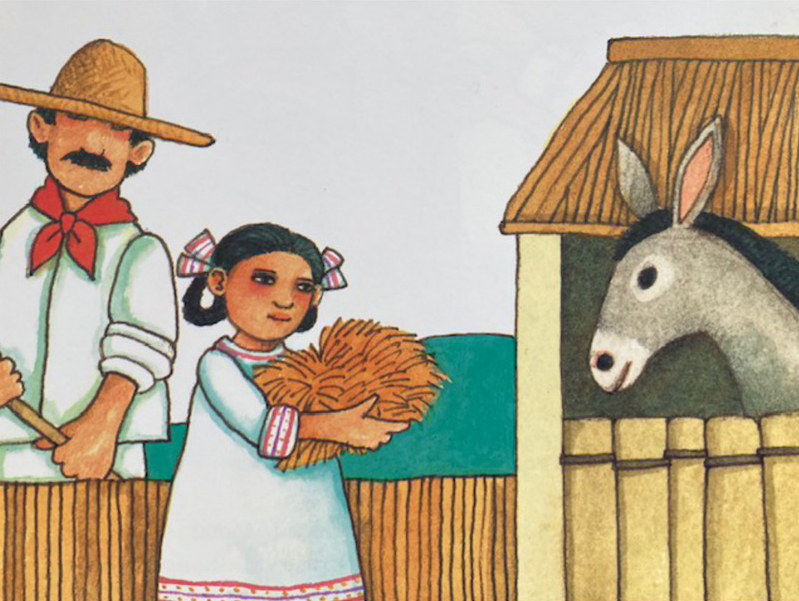
In dePaola's version, Pepita becomes Lucida. She lives high up in the mountains of Mexico with her parents and siblings. Lucinda, the oldest of three children, helps her mother clean their casita and make the tortillas for their meals. And each evening, she goes with her brother and sister to the shrine of the Virgin of Guadalupe to see if fresh candles are needed.
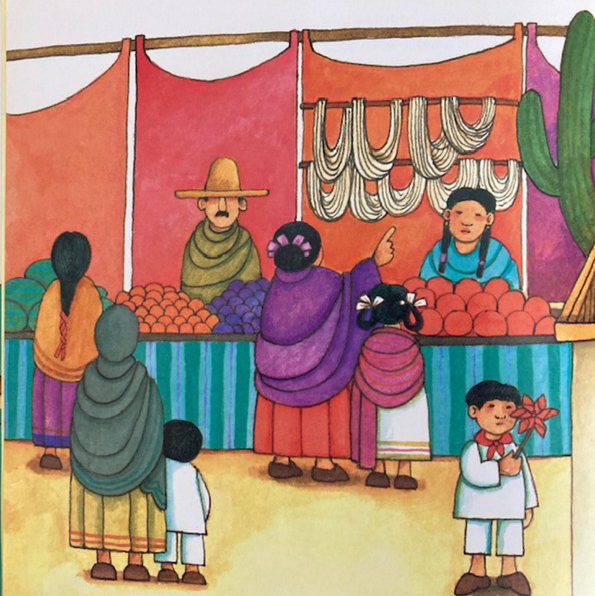
As Christmas approaches, Padre Alvarez, the priest at San Gabriel, the village's parish church, comes to Lucinda's house to ask her mother if she would weave a new blanket for the figure of the Baby Jesus in the church's Nativity scene. "I would be honored," Lucinda's mother says. "And Lucinda will help me." Lucinda and her mother go to the market to buy wool—the finest yarn they can find—to make the blanket. At home, they dye the wool with all the colors of the rainbow and Mama begins to weave the new blanket on a simple frame loom.
As Christmas draws near, everyone in the village gets to work, the fathers busy constructing the manger scene, the mothers making gifts for the Baby Jesus. During the Christmas Eve procession, everyone will walk to San Gabriel, singing and carrying candles. Inside the church, Padre Alvarez will lay the figure of the Baby Jesus in the manger and the villagers will come forward to place their gifts around it. "Our gift will be the blanket for the Baby Jesus," Lucinda tells her friends. "I am helping Mama weave it."
Being the excellent storyteller that he was, dePaola introduces a complication into the simple legend. Lucinda's mother becomes sick and Papa takes her into town to see the doctor. While they are gone, Lucinda must take care of her brother and sister and finish weaving the blanket herself. "But when she sat down and tried to weave, the yarn got tangled. The more she tried to untangle it, the worse it got." Lucinda realizes that she cannot finish the job in time.
She takes the unfinished blanket to another weaver in town, Señora Gomez. "Oh, Lucinda, it is so tangled," Señora Gomez tells her. "There isn't time for me to fix it. Tomorrow is Christmas Eve." In tears, Lucinda realizes that the blanket is ruined and that her family will have no gift to place at the manger of the Baby Jesus.

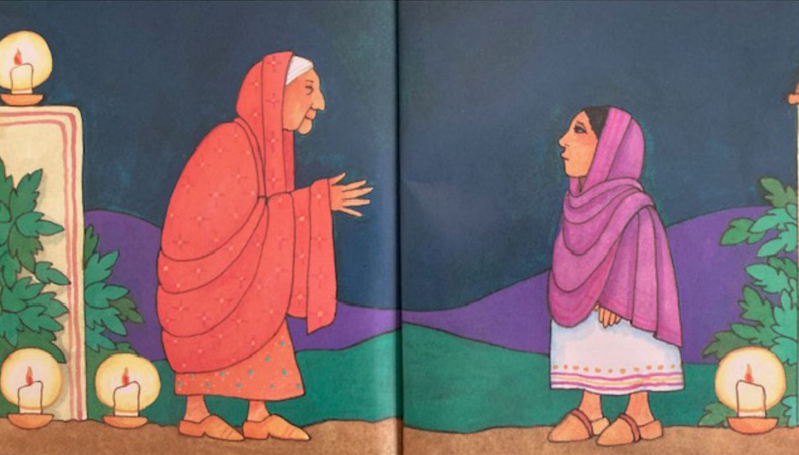
As the procession begins, the villagers light their candles and walk toward San Gabriel, singing Nativity hymns. Hiding in the darkness, a despondent Lucinda watches them go into the church. Suddenly, an old woman emerges from the shadows. "I have a message for you," she tells Lucinda. "Your mama is going to be fine, and your papa will bring her home soon. Go now and celebrate Christmas with the others." Lucinda protests, saying she has no gift to give.
"Ah, Lucinda, any gift is beautiful because it is given. Whatever you give, the Baby Jesus will love, because it comes from you." Lucinda looks around and sees a patch of tall green weeds in a nearby tangle. She picks up an armful and turns to ask the old woman if this humble gift will suffice, but the woman is gone. (Some of the details in this part of dePaola's retelling—especially the appearance of a mysterious woman who announces the miraculous cure of a relative—strike me as borrowed from the story of the Virgin of Guadalupe, where the Virgin tells Juan Diego that his uncle has been cured of a fever. See my article "John Steinbeck's 'The Miracle of Tapayac'" in Lokkal, December 14, 2025.)
With her bundle of weeds, Lucinda enters the church, which is blazing with candlelight. As she walks down the aisle with her simple gift, people begin to murmur. "Why is she bringing weeds into the church?" Lucinda reaches the manger scene. After placing her weeds around the stable, she lowers her head and prays.
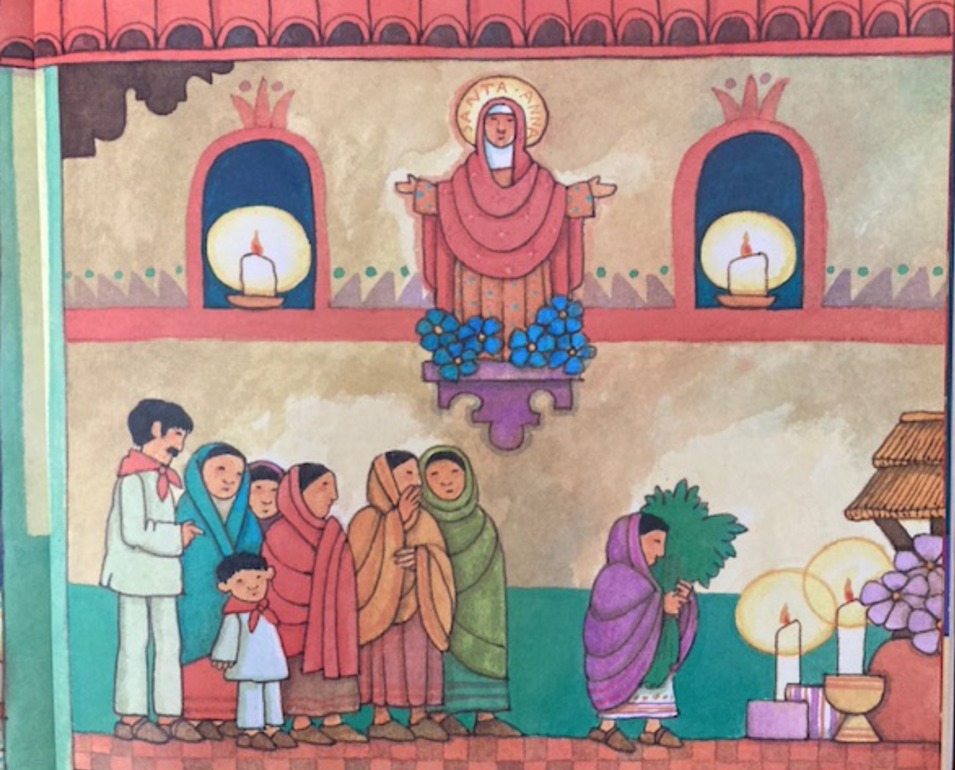
DePaola writes: "A hush fell over the church. Voices began to whisper. 'Look! Look at the weeds!' Lucinda opened her eyes and looked up. Each weed was tipped with a flaming red star. The manger glowed and shimmered as if lit by a hundred candles."
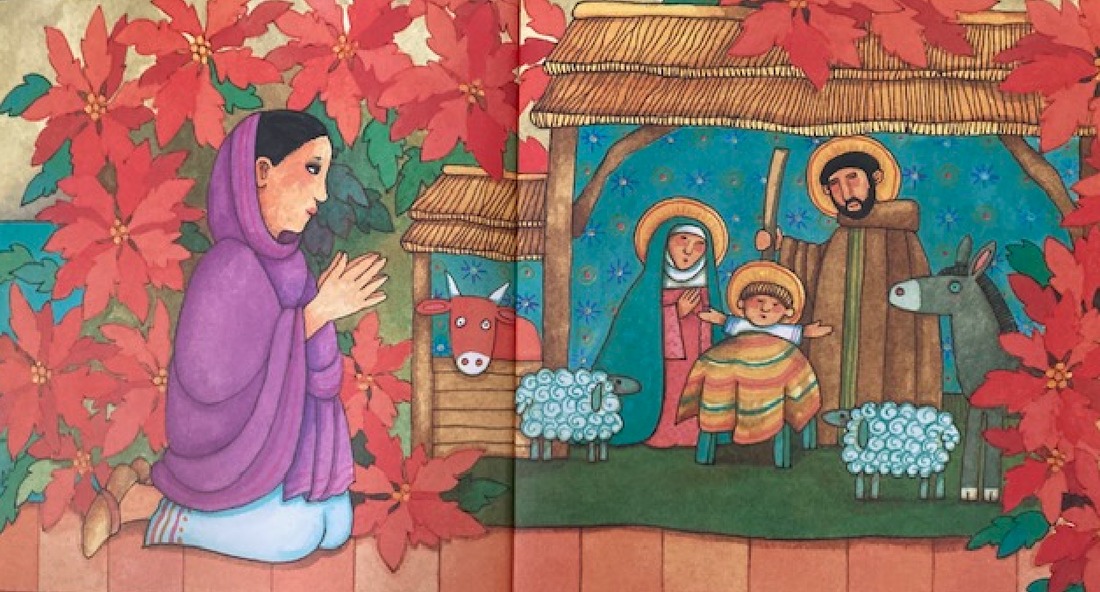
When everyone goes outside after the Christmas Mass, they discover that all the green weeds throughout the town are shining with red stars. "And every Christmas to this day," dePaola concludes, "the red stars shine on top of green branches in Mexico. The people call the plants la Flor de Nochebuena—the Flower of the Holy Night—the poinsettia."
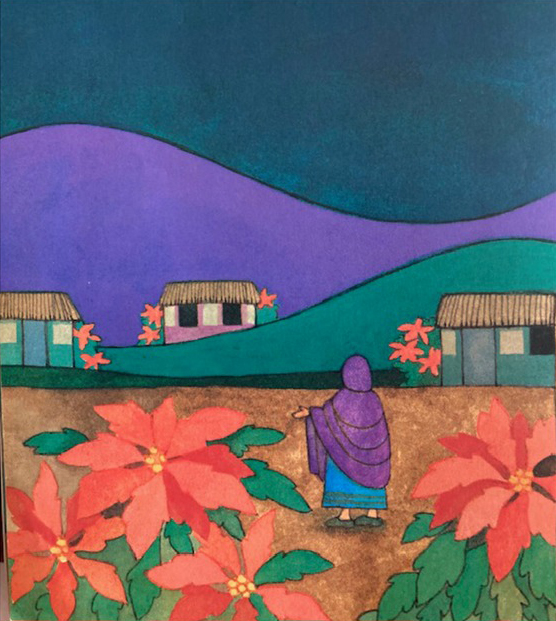
Some readers may find fault with dePaola's depictions of Mexican peasants, which border on stereotypes: the men all sport bushy moustaches and wear wide-brimmed sombreros; the women of the village unfailingly wrap themselves in rebozos. These quibbles aside, dePaola, who over his 60-year career as a professional artist and children's book illustrator won many awards and honorary degrees for his work, is an enchanting storyteller and artist. "The artwork takes center stage," a review in Booklist noted. "The spreads … are magnificently staged and colored."
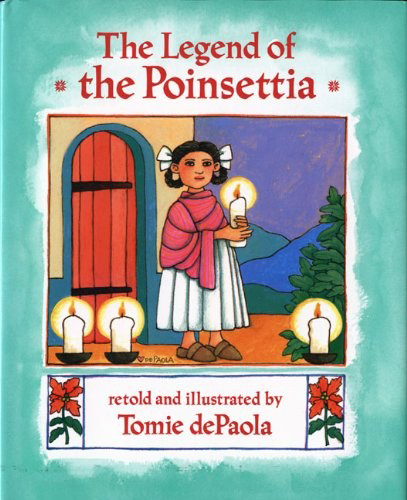
I would agree. DePaola's book teaches young readers a valuable lesson about the nature of gift-giving. As a review in Kirkus Reviews put it, "Tomie dePaola has always had a way with the retelling of folktales—getting them straight without getting them sentimental—and he shines again here with this Mexican story." Moreover, The Legend of the Poinsettia also introduces children to a foreign culture with values and customs that young Americans can learn from. Maybe especially in this year when they hear so many negative messages about Mexico and Mexicans.
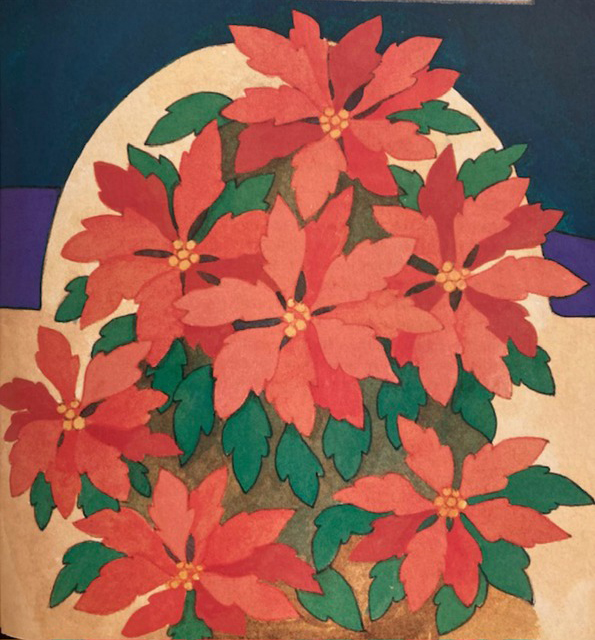
I have been unable to find any evidence that de Paola, who lived most of his life in New Hampshire on a 200-year-old farm, ever visited Mexico. But he gets the spirit of Mexican piety and dignity down just right.
"The Legend of the Poinsettia" is available in a Spanish edition, too.
**************

Philip Gambone, a retired high school English teacher, also taught creative and expository writing at Harvard for twenty-eight years. For over a decade, his book reviews appeared regularly in The New York Times. Phil is the author of seven books. His memoir, As Far As I Can Tell: Finding My Father in World War II, was named one of the Best Books of 2020 by the Boston Globe. His new collection of short stories, Zigzag, was published last year by Rattling Good Yarns Press. His books are available through Amazon and at "Tesoros," the bookshop at the Biblioteca.
**************
*****
Please contribute to Lokkal,
SMA's online collective:
 ***
***
Discover Lokkal:
Scroll SMA's Community Wall below.
Mission

Visit SMA's Social Network
Contact / Contactar