 Español
November 22, 2026
by Roanne Kolvenbach
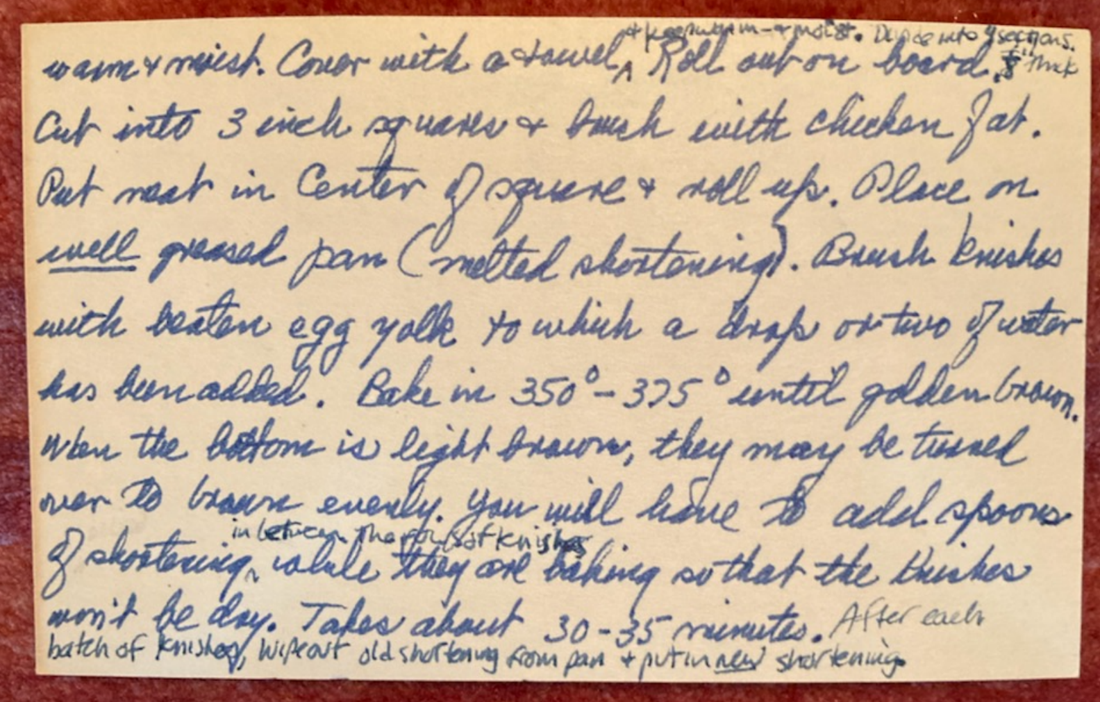
My grandmother was mostly a bummer except in one regard: her knishes. Her recipe is pasted in below, but best of luck to you. She clearly omitted some kind of key fairy-dust, hive-mind mayhem that she assumed future generations would still possess. As if the advent of television and individualism derailed our collective unconscious, leaving us in our modernity having to reinvent the wheel. Attached to the recipe is a letter she wrote in 1981 when she was almost seventy, in an attempt to shepherd us through the process. The annotations on the letter and recipe cards belong to my mother's first cousin, who still couldn't get it right. My first cousin is a professional chef and even his don't compare. Forget the supposed rock stars. Yonah Schimmel on the Lower East Side in Manhattan served hockey pucks topped in glop. Katz's Deli, grease-pit insults. And don't get me started about the ongoing effrontery of most kosher catering.
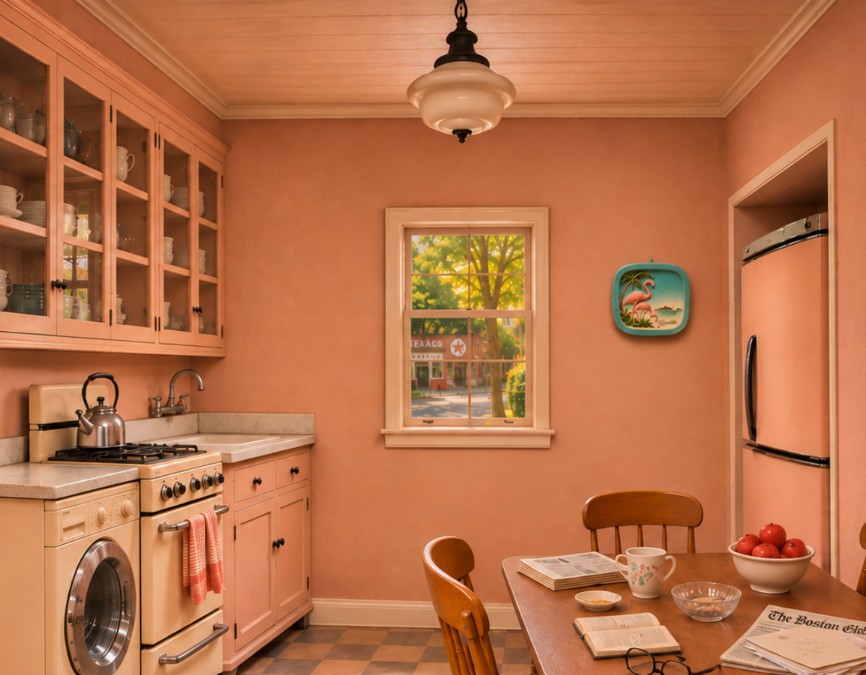
Her kitchen was painted 1940s pink with a pink refrigerator over a pink freezer wherein a grumpy grandchild might sneak tricolored spoonfuls of spumoni. On more than one occasion my mother got an earful about the horror of my manners, and I got an eyeful of Emily Post's 1922 tome on etiquette. None of which diminished how much I loved watching her construct those magnificent objects. Rolling out the dough was a meditative act, performed in silence. Perhaps she could sense disparity in thickness or objectionable texture through the magic wand of her rolling pin.
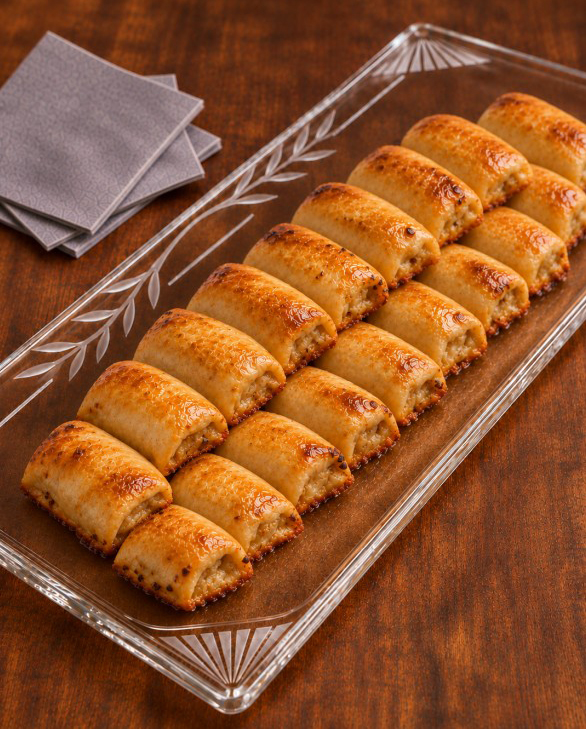
Hers weren't traditional pinched-rounds, but rather petite rectangles the size of a fat finger with a seasoned meat core. She didn't make potato or engage in any other newfangled mishegaas. She used a wooden ruler to measure out the dough with precision. Each exactly the same as the last or it got banished to the reclaim pile. How I wish I still had that ruler, darkened down the edges from decades absorbing the oils from her hands and the dough. She wielded a knife with the confidence of a surgeon and the grip of a lady, always with her ring and pinky fingers delicately curved up in loops. Always that same way, with the last two fingers curled up, whether she was sliding slabs of sputtering potatoes around a cast-iron skillet or spooning knaidel into broth. Everything delicious—every time—like being bundled in a duvet hug during a winter storm.
Thanksgiving would not have been Thanksgiving if not for her knishes, passed hors d'oeuvre style, lined up in perfect rows on a long rectangular etched glass tray rimmed in silver. We spent all year in mouthwatering anticipation. Especially as we began to peel off. Off to college. Off into the world. But always back for Thanksgiving. The consistency of her dough—not flaky like a croissant, nor thick like wontons, nor gummy like gnocchi, and in perfect proportion to the savory meat inside—will forever taste like belonging.
There's a lot of us, often twenty-five or sometimes more for Thanksgiving, so my grandmother had to stockpile them in advance, freezing batch after batch after batch. We could easily plow through a hundred no problem. Somehow she knew, and made just enough to satisfy but not ruin an appetite for turkey and candied sweet potatoes.
One year, after her first batch had gone into the freezer, she fell while taking out her recycling and dislocated her shoulder. My mother happened to be away at a wedding and instead of going by herself to the emergency room, my grandmother, ever stubborn, waited silently at home for two days until my mother got back and could take her. She still came for Thanksgiving but that batch of knishes remained in her freezer. She didn't want to talk about it. Eventually her shoulder healed maybe 70% of the way, but something had broken inside and she died a couple years later.
When my mother cleared out her house she found the batch of knishes in the freezer. She brought them home and placed them in her extra freezer down in the basement, next to the top layer of her wedding cake. Those stalwart ladies kept each other cryogenic company for the next thirty years. Through every Thanksgiving. Through the marriages and babies. Through my father's diagnosis with cancer. On my parents' 50th wedding anniversary the cake was given a brief reprieve and brought upstairs. No touching! Those two remained frozen in place, side by side, through the divorces. Through my mother's declining health. Through my father's death. Until 2020, when I had to move my mother into assisted living during the pandemic.
Clearing the house was brutal. My father built it himself in 1959 and died in it, in 2013, with all of us by his side. His death was shattering. And his house, this place we treasured, didn't have en-suite bathrooms and walk-in closets. No kitchen island. We had to sell it to a developer who was going to tear down and build the kind of house people now want. For sure extracting my mother from the house took years off my life. Keepsakes distributed. Valuables sold. Usable goods donated. Until all that was left were the appliances, so old no one wanted them. And in the basement freezer—the top layer of my parents' wedding cake and the last batch of my grandmother's knishes. I didn't have the heart to throw them out. It seemed fitting that they go down with the ship.
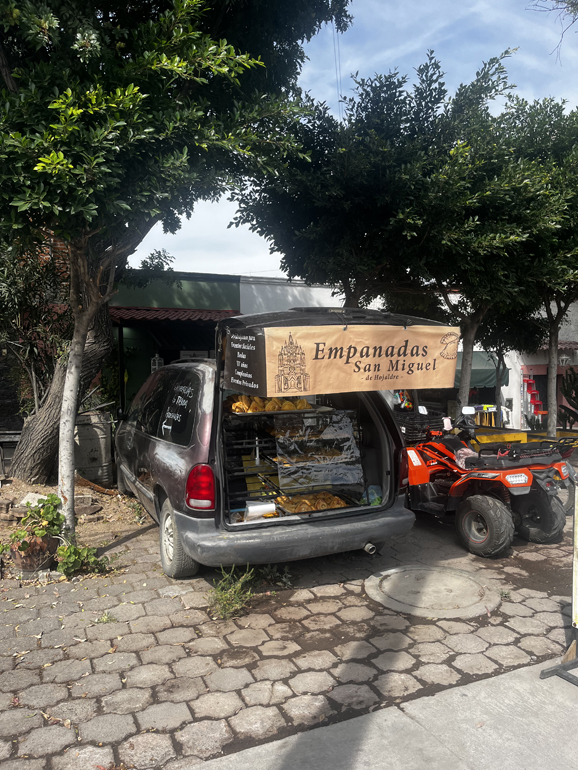
I suffered some lost years. My nest emptied. My mother died. In 2025, adrift and floundering, I quit my job, rented out our apartment, and applied to art residencies abroad. Which is how I ended up here in San Miguel, walking down Salida a Celaya on a September afternoon, isolated, lonely, confused, and hungry. At the corner of Cinco de Mayo, I came across a lady selling empanadas out of the back of her car and bought one and what the fuck… I don't know if it was the proportion of dough to meat or the dough itself—which is much flakier than my grandmother's—and don't tell anyone, but I'd bought pastor (pork!), but something … it hit my tongue and I was suddenly back in that pink kitchen, with the flamingo plate hanging on the wall from that time they went to Florida, with her ring and pinky fingers curled up, holding that ruler and tsk-tsking her tongue because the last row was short. Something. Something. I don't know why, but that taste brought with it a sensation of bedrock. That underneath the chaos and churn, the highs and lows, exists a larger slab of something steady. Something found in watching a grandmother roll out dough and measure it out with precision, preparing for a Thanksgiving feast.
***
The text of the letter above-
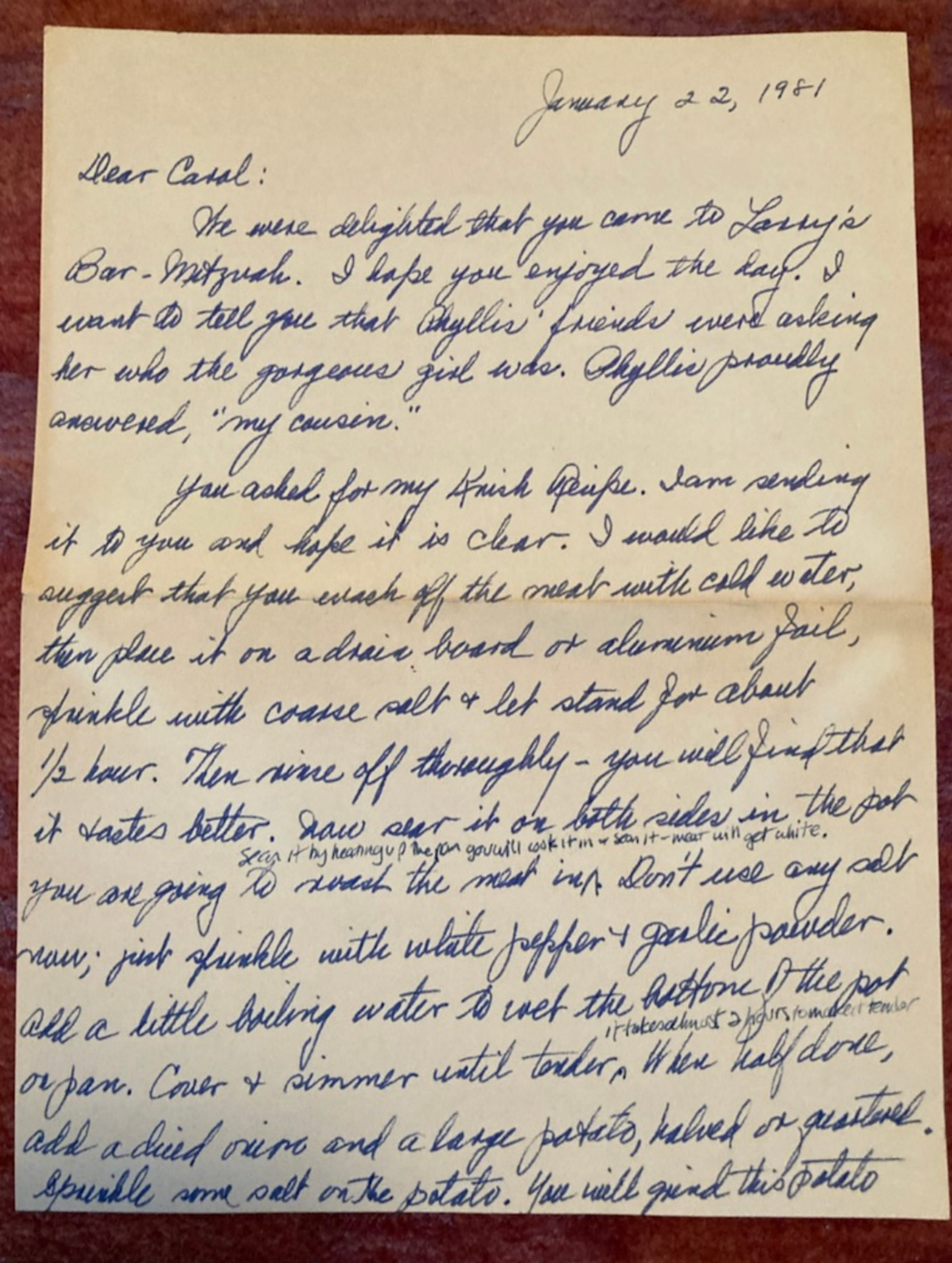
January 22, 1981
Dear Carol:
We were delighted that you came to Larry's Bar-Mitzvah. I hope you enjoyed the day. I want to tell you that Phyllis' friends were asking her who the gorgeous girl was. Phyllis proudly answered, "my cousin."
You asked for my knish recipe. I am sending it to you and hope it is clear. I would like to suggest that you wash off the meat with cold water, then place it on a drain board or aluminum foil, sprinkle with coarse salt & let stand for about 1/2 hour. Then rinse off thoroughly—you will find that it tastes better. Save water?
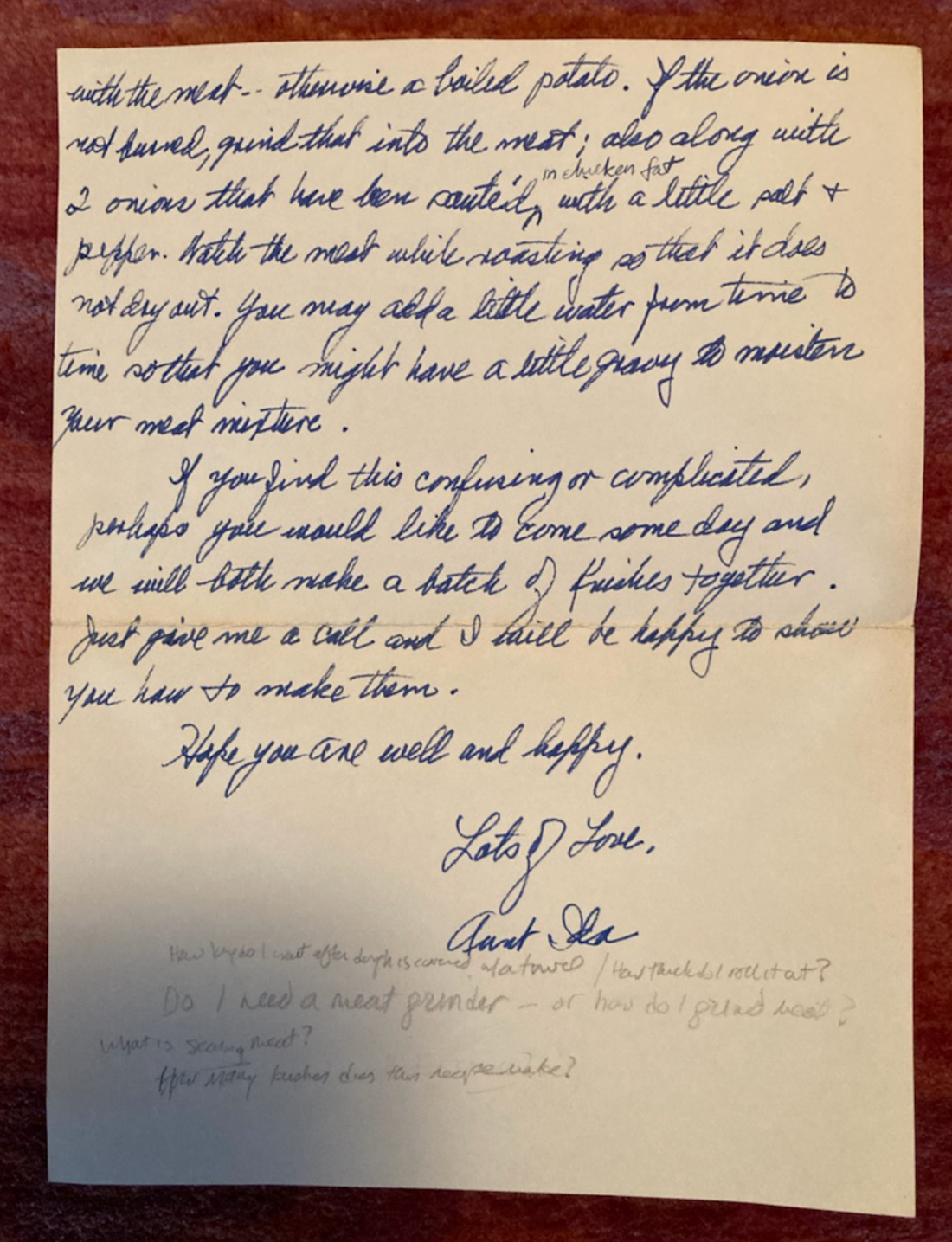
You are going to stew the meat in a pot. Don't use any salt now; just sprinkle with white pepper & garlic powder. Add a little boiling water to wet the bottom of the pot or pan. Cover & simmer until tender. When half done, add a diced onion and a large potato, halved or quartered. Sprinkle some salt on the potato. You will grind this potato with the meat -- otherwise a boiled potato.
If the onion is not tender, grind that into the meat; also along with 2 onions that have been sautéed in chicken fat with a little salt & pepper. Baste the meat while roasting so that it does not dry out. You may add a little water from time to time so that you might have a little gravy to moisten your meat mixture.
If you find this confusing or complicated, perhaps you would like to come some day and we will both make a batch of knishes together. Just give me a call and I will be happy to show you how to make them.
Hope you are well and happy.
Lots of love,
Aunt Ida
- How big do I cut the meat? Is it covered in water? How much salt do I use?
- Do I need a meat grinder—or how do I grind meat?
- What is ground meat?
- How many knishes does this recipe make?
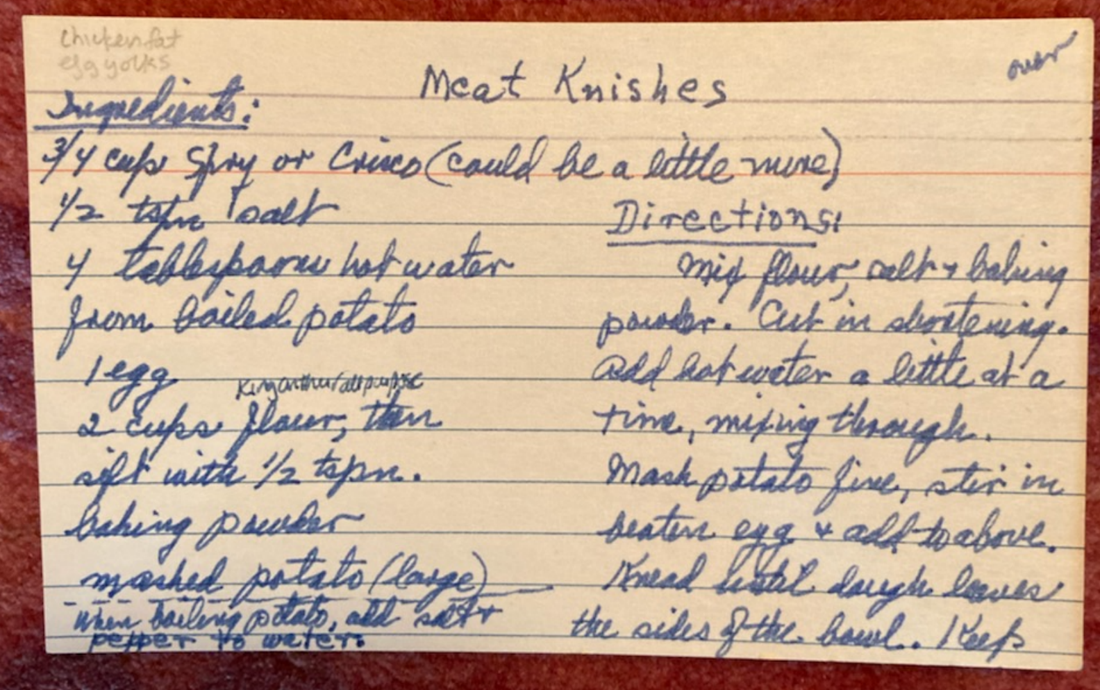
chicken fat
egg yolks
Meat Knishes recipe
Ingredients:
- 3/4 cup Spry or Crisco (could be a little more)
- 1/2 tsp salt
- 4 tablespoons hot water from boiled potato
- 1 egg
- 2 cups flour, then sift with 1/2 tsp baking powder
- Mashed potato (large)
When boiling potato, add salt + pepper to water.
Directions:
Mix flour, salt + baking powder. Cut in shortening. Add hot water a little at a time, mixing through. Mash potato fine, stir in beaten egg & add to above. Knead until dough leaves the sides of the bowl. Keep ...
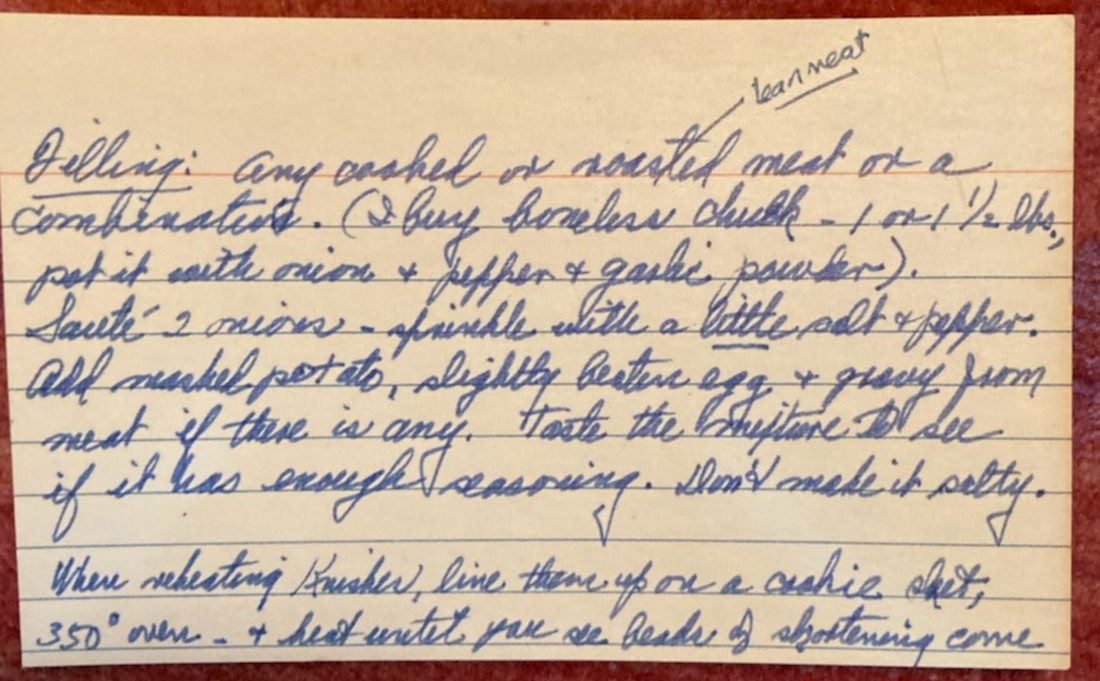
Filling: Any cooked or roasted meat or a combination. (I buy boneless chuck - 1 or 1 1/2 lbs, put it with onions + pepper + garlic powder).
Sauté 2 onions—sprinkle with a little salt + pepper.
Add mashed potato, slightly beaten egg + gravy from meat if there is any. Taste the mixture to see if it has enough seasoning. Don't make it salty.
When reheating Knishes, line them up on a cookie sheet, 350° oven—and heat until you see beads of shortening come up and melt, warm and moist.
Cover with a towel to keep warm and moist, Divide into 4 sections. Roll out on board. Cut into 3 inch squares + brush with chicken fat. Put meat in center of square & roll up. Place in well-greased pan (melted shortening). Brush knishes with beaten egg yolk to which a drop or two of water has been added.
Bake in 350°–375° until golden brown. When the bottom is light brown, they may be turned over to brown evenly. You will have to add spoons of shortening while they are baking so that the knishes won't be dry. Takes about 30–35 minutes.
After each batch of knishes, wipe out old shortening from pan & put in new shortening.
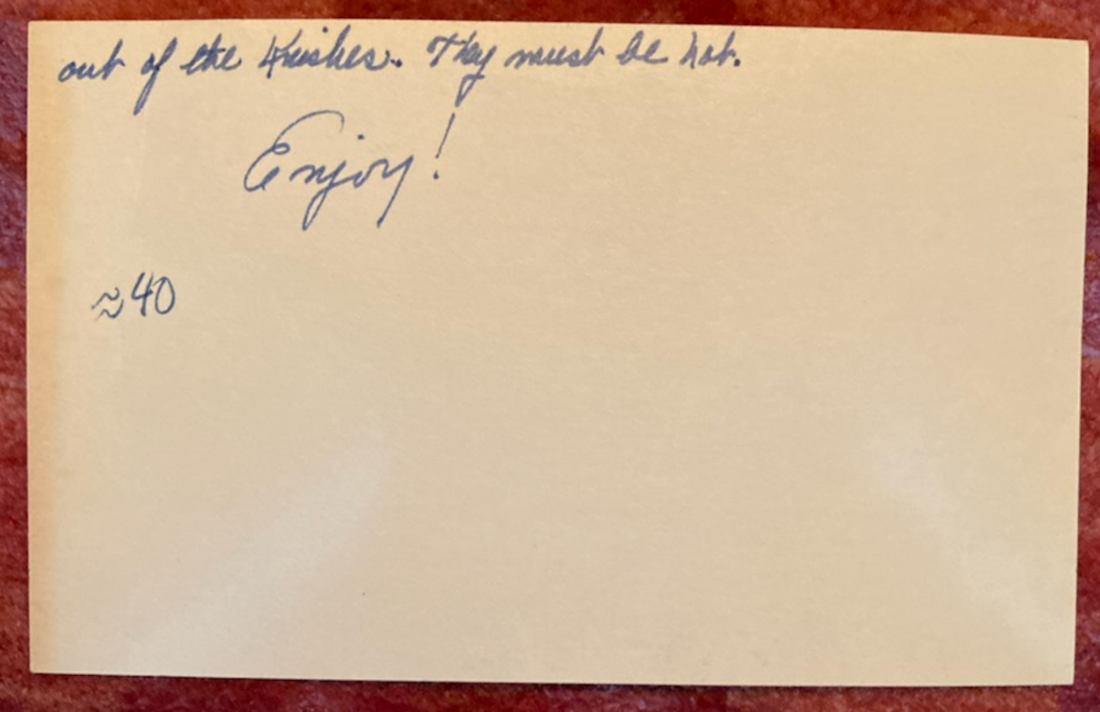
Out of the Knishes. They must be hot.
Enjoy!
40
***************
Roanne Kolvenbach is a writer, artist, entrepreneur, optimist and voter. Her visual and written work move fluidly between intimacy and structure, humor and grief, purposefully blurring the boundary between art and commerce. Her memoir Selvage about her mother’s recent and grueling death, was long-listed for the 2026 International Voices In Creative Nonfiction competition.
Armed with a BFA in Studio Art from Tulane University and an MFA in Creative Writing from The New School, she’s lived in 8 apartments and 3 houses, has had 2 dogs and 2 children, been swept up in love 3 times (not including the children) and buried in grief twice. Her most favorite days begin early on Ballston beach with her dog Caesar, followed by grilling sourdough and tomatoes for her family to eat with fresh mozzarella and a little basil. Although now she lives in Mexico, writing and working in clay.
**************
*****
Please contribute to Lokkal,
SMA's online collective:
 ***
Discover Lokkal: Mission

Visit SMA's Social Network
Contact / Contactar