 Español
July 12, 2026
Previous chapters
by Jan Baross
CHAPTER TWENTY-NINE
Beneath a full moon, the tide stretches up the sand in wide sheets of silver. Tumbling moonstruck crabs quickly bury themselves in the rushing water.
Ahead of us under a tall pine, the Hermit's hut glows from within. It is made of smooth driftwood logs stuck in the sand and fastened side by side like a fort. Between the bleached logs is the glow of a cookfire, where the shadow of the Hermit's body passes back and forth.
José and I try to keep up with Pilar's pace, her small sandals churning through sand toward the hut. The stiff new dress scrapes my legs, thanks to Pilar, who would not give me a moment to change.
Gabito floats beside me over the sand as though he were stretched out in a hammock.
"Most girls would sit quietly after a proposal and weep with gratitude," I say silently to him. "But not this little nun. All her questions have to be answered tonight: ‘Can the Hermit remove the curse? What if the Hermit can't remove the curse?' Gabito, we are doing an evil charade. The Hermit cannot remove the curse or he would have done it by now. Poor José."
Gabito turns in the moist night air. "Tortugina, do not be so quick to see the dark side of life."
The dead can afford to be optimistic. And Gabito does not live inside José the way I do.
Only a few feet from the Hermit's front door, our sandals crack on hundreds of brittle clamshells covering the sand. This popping is a good alarm for the old Hermit to hear our approach.
The Hermit pulls back a heavy carpet that hangs across his doorway. His uncombed hair has worked itself into long, thick tangles that would scare a tarantula. It is said that he never bathes, and when his ragged tunic of animal skins rips, he simply sews on another loose piece. He moves toward us in layers, like a molting beast without all its fur truly attached.
In the moonlight, I hold my breath against the combined stench of his sweat and badly cured hides. His ragged beard glistens with animal fat.
"Speak," says the Hermit, "and hurry. I left my potion bubbling."
His amber eyes glow under a protruding brow.
Pilar approaches. "Señor Hermit, I want you to remove the ancient curse on the house of Svendik so that I may marry José Svendik."
His lips part in the moonlight, revealing a crooked smile.
"Marriage?" he says. "Marriage is a dangerous journey that only fools take."
"What does it cost?" asks Pilar.
She is practical as well as relentless. Good traits for our dreamers' bloodline.
The Hermit's prodding tongue loosens fish bits from the gaps in his teeth. He spits and small shots of white fish hit the sand.
"Death is one cost," says the Hermit. "Death is common among people who seek to change the past. Think of that before you volunteer, Señora Tortugina."
"Me?" I say. "This little nun is the seeker."
"Señor Hermit," says José. His face is a shield in the silver moonlight. "It is I who will face death for Pilar's love, not my mother."
The Hermit's eyes glow like his cookfire as he circles José.
"You?" he asks. The old shaman pokes José in the chest. "Are you telling me my business? It is only the wife of the senior Svendik who can lift the curse. That is Señora Tortugina."
The Hermit's amber eyes leave a cold chill in my chest.
"I will divorce Miguel and let Fecunda marry him. Then she will be the number one Svendik wife."
"Do not argue with me," says the Hermit. "Fecunda asked me, and I told her the same thing. As curses go, you are Miguel's wife now, his only wife, the one who can lift the curse."
At the risk of angering him, I ask, "But in all these generations of Svendiks, why is it another wife did not come to you for uncursing?"
He turns to sniff his potion. It smells like something is burning.
"Most people lack imagination, Señora. They do not want to change things. That is why the world is the way it is. But you are here."
Gabito wets my ear with a kiss. "If you do not survive, we will be together sooner. There does not appear to be a downside to this arrangement."
The chill has taken hold of my bones. I pull my shawl tighter and thread my arm through José's arm. Love never leaves a choice, and that is unfair.
"Do you really want this little nun?" I say to José silently.
He nods. I give him the answer he wants.
"I will do it for you, José."
There are no happy endings for martyrs. José takes my hand.
"But Mamá, I cannot let you risk your life for me. I love you too much."
Thank God. I inhale deeply, safe in my son's love. It was a hard choice, but my José has spoken. The little nun loses.
Pilar wraps her white fingers around José's other arm.
"José, we must allow your mother her sacrifice." There is an edge to her voice. "It is for our children's sake."
My fingers tighten around José's hand.
José stands between the two of us and looks up at the night sky. When he turns to me, his eyes glisten.
"I am sorry, Mamá. You are my soul, but Pilar is my heart. What is a man if he does not listen to his heart?"
I should make this easy for him, but I do not.
"What do we call the wise son who carries his mother first in his heart?"
"Single," says Pilar.
Gabito knocks my shoulder. "Tortugina, stop torturing the boy."
The Hermit rubs his black fingertips in front of my face.
"Ten chickens and I will be gentle," he says.
"No one pays ten chickens, except for a burro. Five," I say.
"Uncurses take all night," says the Hermit. "Eight."
His sour smell is beginning to make my eyes water.
"Five or we go home," I say.
The Hermit's square fingers pluck a pine needle from my hair. "Seven is my last offer."
Pilar pushes José forward. "I will return with seven chickens," he says and quickly puts out his hand.
The Hermit shakes José's hand. "Return as quickly as you can, José," says the Hermit. "Once I begin, there is little time left for the uncursing, and I need you here for that."
The Hermit pulls out a knife and whacks a strand of José's hair off of his forehead.
"Why did you do that, Señor Hermit?"
The Hermit moves his arms up and down like a rooster. "Roll the bones, suck an egg. I am a busy man. I do not explain my magic, boy."
He gestures toward the hut. "Señora Tortugina?"
José starts to embrace me. The Hermit steps between us. "Your mother is mine now. Go get my chickens!"
José allows Pilar to steer him back to the village. Their sandals sink to the same depth in the dune. This may be my last sight of him.
The Hermit holds the rug door open for me with a most courteous bow.
"Señora Tortugina," says the Hermit.
His voice has turned musical and creates a soft lure. I step inside the hut onto woven rugs thrown two and three deep across the sand floor. A small cauldron bubbles on rosy embers. It smells like burning seaweed. The scent of heavy smoke and many meals rises from the wool carpets.
Gabito floats to an ancient loom strung with crimson threads and pretends it is a harp. He wants to entertain me before I die.
I catch the Hermit's gaze on my breasts. His eyes travel down my legs.
Gabito's eyes snap. "Smelly beast!"
"Señora Tortugina, you are aging well," says the Hermit.
I edge as far away from him as the hut allows. "It is the new dress," I say.
He slaps the bed covered in red blankets. "Lie down, Señora."
Gabito plucks the strings of the loom nervously. I step around the embers and sit on the bed.
The Hermit slips the shawl off my shoulders and pushes me back onto the red blanket that reeks with sweat. With a humming-bird touch, he unstraps the buckles of my sandals.
"I am starting to be frightened, Gabito," I say silently. Gabito swings his legs over the loom and hunches toward us. "Me too."
The old man moves to a low table covered with colored bottles. He pours a blue and then a green oil over a fresh bird fetus lying in a dish. Using the oil-covered bird like a bar of soap, he washes his hands with it. Then he presses his fingers onto my feet in a gentle massage. It reminds me of rubbing Papá's calloused feet, "onions and bunions and carrots and tomatoes."
"Be tranquil, Señora Tortugina," he says.
The Hermit's fingers slip between the tender valleys of my dry toes. A sweet warmth invades my skin. The fetus oil, his touch, are a soft narcotic. I feel suspended in warm honey, drugged by the rhythm of his fingers releasing muscles that have been clenched for a lifetime. My body loosens like an old robe falling open.
Out of the corner of my eye, I see Gabito rise off the loom. He turns his head away, his face as red as the blankets. "I will go crazy if I watch this."
"Please," I whisper. But the Hermit's hypnotic touch and the calming oil lull me to sleep.
I am half-awakened by the sound of the Hermit chopping the lock of José's hair into small pieces that he brushes into a dirty white bowl. Adding purple powder from a rusted box, a pinch of something scaly-green, and a small handful of tiny dark beans, he throws it all into the hot, black, soupy potion bubbling over the fire.
Pouring the soup into a small bowl, stirring the potion with his knife, he holds the steaming bowl to my lips.
"Drink this, Señora Tortugina."
A strong, sweet smell like black molé rises from the soup. A few beans floating on the top appear to have legs. I turn my face away.
The Hermit speaks slowly, or I am listening slowly.
"When you drink this potion, it will make your blood go backwards. Then Señora Sepulchura, whom I have summoned from the grave, will enter your body. Your body will become hers for a short while. José must persuade her to lift the curse. There is very little time to make this work."
The Hermit presses the bowl to my lips.
"For José," I say, and swallow the muddy grit that fizzes in my teeth. The hairs cling in my throat. Coughing and choking with the last swallow, I gulp hard against the awful prickling. The Hermit forces a mild wine down my throat. A few swallows cure the gagging.
"Has anyone actually survived this?" I cough.
"You are my first uncursing," says the Hermit. "I am using my great-grandfather's formula." He pauses and feels my forehead. "And now it begins."
I inhale and my breath is on fire. I exhale and my breath is like ice. I know that I am going to die.
"Courage," he says.
Time is pouring backwards. Cold sand slips through my heart that has become an hourglass.
"Gabito!" I scream in terror. My hinges creak. My spine is made of wood. I am a coffin.
"Tortugina," says Gabito. "All we can do now is think of our son."
What I think of José at this moment, is the same thing Mamá said to me: "I should have killed you before puberty."
The Hermit shakes my shoulder. "What do you see, Tortugina?"
An old woman comes toward me out of a long tunnel. She is dressed in the dark clothes of another century. I recognize her from the ugly portrait in the church where I prayed to Saint Uncumber. It is the ancient Señora Sepulchura, Miguel's great- grandmother, the one who laid the awful curse on her family.
The old woman holds her swollen belly as though she were pregnant. Her filmy eyes look down at me. She bends slowly to sit on the bed then lies down on top of me, the coffin that I have become, and sinks into my flesh. My body rumbles, shaking bones begin to crumble, my skin shrinks with decay until I am the ancient Señora Sepulchura.
The Hermit steadies a piece of rusted mirror in front of my face. My breath clouds the edges. Señora Sepulchura looks back at me from the mirror.
"Holy Mother of God!" I try to yell, but my mouth is full of her yellowed ivory dentures. They chop my words to bits.
I blink in the mirror. She blinks. She is me! I am her! It happened so quickly. The old woman is even uglier than her portrait in the church alcove. Silver hair halos a sunken face. Her quivering neck is anchored to a sunless chest. Terrible stained-laundry flesh, yellow fingers curled with arthritis. I pull a layer of creped skin out from my cheek. Skin as dry as peanut shells recedes slowly back to the bone. Even that small movement is painful with these swollen joints.
The Hermit covers me with a blanket. The pressure of the weave is too much. I try to look up into his eyes. My ancient vision is smeared with jagged dark forms floating across a gray-white sea.
"Do not worry, Señora Tortugina," he says. "A softer vision of life compensates for the hardening of arteries. Accept your new limitations with grace."
He massages my bony shoulder.
"You must go now. Sleep and make room for our guest. I hope you can avoid whatever pain she brings with her."
"Wait!" I want to yell. I try to inhale deeply, but the old woman's lungs are fragile from so many years in the grave.
The Hermit shouts into the old woman's ears. "Señora Sepulchura! Wake up!"
She crowds me out behind the watery eyes we share. I am a woman trapped in another woman's body. I am a wanderer in her petrified landscape. This is a preview of death. Will I ever return to the contours of Tortugina? A gurgling moan rises in our throat.
"Señora Sepulchura?" The Hermit bobs close to my face / her face.
Her awakening brings a sudden sharp pain in my belly. The old Señora pushes her tongue against the ivory teeth.
"Wuh," says Señora Sepulchura.
She uses the heels of my palms to push on the blanket. The hot pain in her womb spasms.
"What!" The old Señora inhales. "What infidel dares to wake the dead?"
Her voice scratches like a branch rubbing against closed shutters.
The Hermit leans toward us. "Señora Sepulchura. I am the Hermit. My great-grandfather was the Hermit in your time. You knew him well for his erotic potions."
The old-woman voice sniffs, "You smell as foul as your ancestors. Send me back to the arms of death now, you evil animal. This is my time to sleep my pain to ash."
Reaching her gnarled fingers under the blanket, the old Señora feels my stiff dress. "Who dressed me in these horrible clothes? I was buried in my blue silk dress, a lace mantilla, and silk underwear." Her trembling fingers knead her swollen womb. The Hermit places his palm over the same spot, and the pain recedes to a dull ache.
"I brought you and your evil disposition back," says the Hermit, "to remove your curse from the house of Svendik."
The Señora releases what little air is left in our lungs. It sounds like laughter.
"Remove the curse? Thor Svendik murdered me with his seed. Mounted me like a stallion! I would never help a Svendik! I want to die!"
I taste salty blood as her ivory dentures grind against our gums.
The Hermit speaks with impatience. "Señora, we are short of time. When you remove the curse, I will let you return to the hell that you deserve. They are paying me seven chickens."
The Señora raises her eyebrows. "Seven?"
She closes her watering eyes and folds her hands across her chest as if in prayer. Under the darkness of her paper eyelids, the old Señora says, "I died once without your help, Hermit. I will do it again."
****************
We are awakened in the dark of early morning by clamshells splintering under a hurried tread. Outside the hut, the sound comes closer and closer. A chicken squawks, then another.
Señora Sepulchura opens our thin eyelids. Her tears blur sight. She presses her fingers into our tender belly and moans, "I did not die."
A breeze carries José into the hut.
"Señor Hermit!" he says. "I have brought you seven chickens. How is my mother?"
José is a smeary silhouette at the edge of our sight. He holds flapping chickens by their bound legs, lowering the bouquet of brown wings to the Hermit's red carpet.
The Hermit's voice rumbles like the earth turning.
"José, this woman is, by marriage, not blood, your great-great-grandmother, Señora Sepulchura. Your mother is asleep inside the old Señora."
"Mamá?" José steps forward and looks down at our old face.
"She will return good as new when we are finished," says the Hermit, "if all goes well."
The Hermit wraps us cigar-tight in a red blanket.
"Here, take her. Take them. I have done my part."
He places us gently in José's arms.
"What do I do?" says José.
"Carry her to the Square of Don Pedro the Cruel and the Just," says the Hermit. "Lay her on the steps of the Illustrious Victims Church, where she made the original curse, and ask her to remove it. It is simple."
"Mamá," says José. "What have I done to you?"
His falling tears are quickly absorbed into our parched skin.
The Hermit gestures toward the village with a chicken. "Hurry, boy. You only have a half-hour left. Do not waste your mother's sacrifice."
José has never looked at me as he does now, as a stranger. I feel the loneliness of burial inside the old woman.
I know he cannot hear me, but I shout as loud as I can, "José, I love you!"
José's fast stride toward the Square of Don Pedro the Cruel and the Just jolts the old woman's spine. Roof dogs bark down at us as we pass. Through the Señora's blurred vision, the village looks completely different, as though it had turned to liquid. Purple bougainvillea pours down a wall like wine. A plot of white chrysanthemums is spilt milk. Trees are leafy green splashes against a blue wash of sky.
The clang of beating, metal on metal, signals the garbage wagon's early morning passage through the streets. Piquante, the tiny mayor's son who is never without a question, clings to the wagon and shouts, "Is that a corpse you are carrying, José?"
He jumps off the back and runs after us. "Let me see!"
"No, Piquante, she is not dead."
José lifts us higher in his arms.
José's sandals slap faster and faster against the street stones. Finally he turns the corner into the gray morning light of the Square of Don Pedro the Cruel and the Just.
José's long-legged strides take us past the scent of freshly brewed coffee from Señora Nauseobondo's taverna. After one hundred years without so much as a sip, Señora Sepulchura's senses turn lucid just from the smell. She awakens her long-dead nerve endings by inhaling.
"Coffee. Now!" whispers the Señora. "Or I cannot lift my head, much less consider lifting a curse."
"Señora, we must hurry," answers José.
"Get me a cup!" she says.
José returns quickly to the taverna and lowers our stiff body onto one of Señora Nauseobondo's empty tabletops. The old vertebrae crackle like fireworks on the table's flat surface. José covers our face with the red blanket.
Señora Nauseobondo's high heels click toward us. "Who is that person?"
Even under the blanket, I can smell the strange eucalyptus perfume of Señora Nauseobondo. It is a sex-smell that always tumbles before her in the breeze.
"Please hurry, Señora," pleads José. "A cup of coffee for the old woman."
Piquante jumps for a peek. José pulls the blanket completely over the old woman's face.
"José has a corpse!" yells Piquante.
"She is not dead," says José.
"José," asks Señora Nauseobondo, "you lay a corpse on my table?"
Chairs scrape against the cobblestones. The villagers rise out of their coffee conversations.
"José," says Mayor Perfecciona. "As mayor, I must point out that it is bad luck for the dead and the living to share commercial property!"
The deeper voice of Sheriff Nina speaks over us. "José, are you involved in a crime?"
"No, no, the old woman is not dead," José says.
The villagers press shoulder to shoulder around the table. Señora Nauseobondo pulls the blanket back. Our watery eyes blink up into an umbrella of brown faces.
"Where is my coffee?" says Señora Sepulchura.
Piquante jumps up and down and screams like a parrot. "She is alive! She is alive!"
"Who are you, Señora?" asks Señora Nauseobondo, as she tilts the coffee into the old woman's mouth. The thick, sweet Arab gruel of Señora Nauseobondo's coffee eats its way down to our empty belly. The old woman clamps her ivory teeth on the rim of the cup from pain.
"Who is she, José?" says Señora Nauseobondo.
"I am Señora Sepulchura," she says, clearing her throat.
"La Scorpion?" whispers the little mayor. "Can that be true, José?"
José coughs and nods. "The Hermit did it."
Mayor Perfecciona crosses herself. "Piquante, go find Padre Monástico!" she says. "This is not a civil matter."
Piquante turns away from the table and shoves his way through the stand of legs. The villagers pull noisy prayer beads out of their pockets and stare at us.
"Look at all of you," says the old Señora. "Your ancestors were as dull as a poor man's plow, and your faces bear the same stamp."
Señora Nauseobondo's face hangs over us and looks more fleshy than usual under her dense cinnamon hair.
"Señora Scorpion, death has not tempered your sting," she says.
"You," says Señora Sepulchura, "must be descended from that circus fur-piece, Señora Peluda. She, at least, would have had the good manners to feed me."
Señora Nauseobondo dips her fingers into the yellow brine of her olive jar. She slips a hot green olive through the old woman's elephant-ivory teeth as though her mouth were a mail slot. The old woman chews, and her gums bleed. She spits the bloody pit out on the table.
"José," says Mayor Perfecciona. "With all due respect, why would the Hermit bring back this piece of trouble?"
José's face is as red as the old woman's blood.
"I hired him," he says, "to bring Señora Sepulchura back from the grave to lift her ancient curse, so that Pilar Peres will accept me as her husband."
"Ahhhh, yes, love," sigh the villagers.
Señora Nauseobondo pinches José's cheek and smiles her red lipstick smile.
"Romance. A groom without a curse is much better than a bachelor with a curse!"
"What is happening to her?" says Sheriff Nina.
The old woman screams, and I scream inside the horror of her flesh. Señora's womb is under siege again. Nerves flay and spark.
"Oh, God, help me!" She holds her womb with bent fingers. Her tears run to drool. "I cannot die this way again!" she screams.
José picks her up off the table. "Please do not die yet, Señora." He runs as fast as he can over the cobblestones.
The villagers follow her wailing across the square to the Illustrious Victims Church. José lays her gently on the top step. The old woman pushes José's hand into the blanket between her legs. He leans close to the old woman's chattering teeth.
"What do you want me to do?" says José.
"Oooww!" she screams. "Take it out! Take it out and I will recant the curse!"
José's eyes are trapped animals running back and forth. "Take what out?"
The old lady wraps her snake-blue fingers around José's wrist.
"Put your hand inside me. You are my great-great-grandson. You are the one to pull it out!"
José gags. "Put my hand inside you?"
"Hurry!"
Poor José. I cannot help him in my silent tomb.
The villagers whisper, "No, no, no."
José wrenches his hand free. "Reach inside my own mother, my great-great-grandmother?"
My heart cracks a little at the horror in his eyes. José has never looked at me with such repulsion.
The old Señora's thick yellow nails press into the blanket.
"Hurry! I will be dead before you get your wish," says Señora Sepulchura. "Close your eyes. Think of your beloved bride. Reach in and pull it out."
"Pull out what?" says José.
Prayers cannot shield him from this.
"Do it, José!" Perhaps he hears me, because he takes several deep breaths as I have taught him to do when he panics. He allows the old woman to guide his hand under the blanket.
Sheriff Nina shushes the crowd of villagers. Señora Sepulchura breathes as deeply as she can.
José wrinkles his nose against a stench even I can smell. His hand jerks back at first contact with her clotted thigh. He turns his head farther away the closer he gets. The Señora gags on her drool and spreads her rusty bones for him.
Señora Nauseobondo, still carrying her jar of olives, kneels beside José.
"It is all right, José. You can always go to confession."
José chants, "I love you Pilar! I love you Pilar!" His hand enters curtains of dry flesh.
"Further, José," whispers Señora Sepulchura.
Her legs are spread as far as the old joints are willing to part. Tears pour out of José's eyes.
"Still further," she whispers. "You are almost there."
Poor José's arm is so far under the blanket that his chin rests on her stomach. His nostrils are turning white.
"I feel something," he chokes.
His clawing finally grasps something hard.
"Pilar! Pilar! Pilar!" he shouts.
Señora Sepulchura screams.
José's fingers yank the lump out. He drags it up and lays it on the blanket for all to see.
It is a calcified child, long dead, no bigger than a large bun and sticky with blood.
The old Señora releases a sigh she has saved up for a century.
The villagers step back, holding their noses.
Señora Nauseobondo quickly slips off her wine-stained tavern apron and wraps the bloody relic with so many layers of generous cotton there is no way to tell if it had a human destiny.
José plunges his hand into Señora Nauseobondo's big olive jar. Green olives roll as he froths the yellow brine red with a vigorous washing. He dries his hands on his dirty white shirt. The smell of José's briny skin is a relief from the womb stench.
The little mayor tucks the red blanket around the old lady's brittle shoulders.
"Ahhh," sighs Señora Sepulchura. "It was worth coming back just to die without that pain."
She sucks contentedly on her loose teeth. In and out, in and out against her bloody gums. Her heartbeat is as subdued as a glassy tide. I am sleepy with relief.
With Piquante leading the way, Padre Monástico pushes through the villagers. The old priest is winded from running. Señora Nauseobondo holds the smelly bundle at arm's length and tells the brief story of the apron-wrapped fetus. Padre Monástico nods.
"Et Spiritus Sancti," says Padre Monástico. "I will christen it, and then we will bury it in the graveyard. Señora Sepulchura, what do you want to call it?"
The old Señora, weakened by the birth, whispers, "José. Call my baby José, after my great-great-grandson."
At least she appreciates one man in her life.
"I will relieve you of this one curse, José," the old woman says. "But it hardly matters. No one can escape the terrible curse of life itself."
José is ready to spit with anger. He leans close, and for the first time in my life, his face frightens me.
"It is you who cause your own suffering, old woman," says José. "I will bury your ugly words with your dead baby. Recant the curse now. I want to see my mother, who is worth loving!"
The village is quiet. Not a dog barks or a child cries. The only sound is the old woman's quiet breath.
"The curse," she whispers, "of all Svendik men to know only the suffering of love, without the joy of love, is over. From this day forward, the House of Svendik, its women and its men, shall know everlasting love. If there is such a thing."
José slumps with relief. Then he jumps to his feet, raising dust off the stones. He jumps even higher than Piquante's head. His fists are triumph-high in the air. Sheriff Nina catches him in her giant arms and hugs him. When she sets him back on the steps, Señora Nauseobondo kisses him on the mo"uth. Piquante jumps on his back. Villagers pound him and kiss him.
"I love you all!" he cries. José frees himself from their hugs and kneels beside me.
Mamá, thank you! Come back! Mamá, wake up! It is over!"
He shakes my shoulders. The old woman's pulse slows and finally stops. I am caught below the surface of her dying flesh.
José, my last look at you is through a spiderweb of veins and far-away light.
Read more chapters
**************
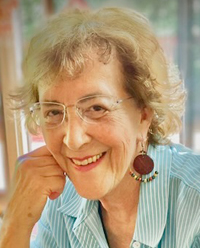
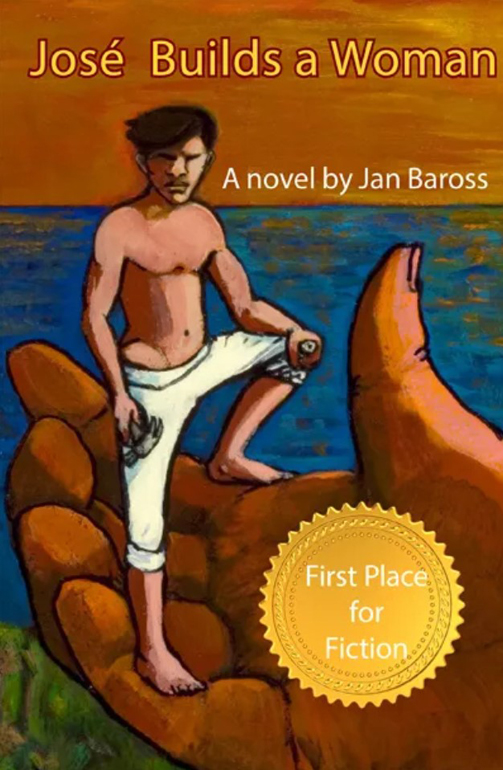
Jan Baross is an award-winning novelist, documentary filmmaker, photographer, screenwriter, librettist, film critic and taught filmmaking at Oregon State University. "Jose Builds a Woman," her debut novel published by Ooligan Press twenty years ago, in 2006, received first place for fiction. Ursula Le Guin gave it a thumbs up.
Baross lives six months a year in Portland, Oregon and SMA where loves designing posters for the Annual San Miguel Playwrights Winter Showcase. Books and Audible on Amazon. Films on YouTube.
www.janbaross.com
**************
*****
Please contribute to Lokkal,
SMA's online collective:
 ***
***
Discover Lokkal: Mission

Visit SMA's Social Network
Contact / Contactar