 Español
June 28, 2026
by Charles Miller
Okay, Okay… two weeks ago I promised to write on this subject but last week put it off in order to address a different subject due to current events. I had promised that I would address the subject of clues for how to recognize YouTube videos generated by Artificial Intelligence. As of January 2026, YouTube has required all creators of uploaded videos to disclose AI-generated content in the form of a checkbox on the upload page that requires declaring "altered or synthetic content." Failure to truthfully disclose AI videos triggers an enforcement system that hits the creators where it hurts: reducing shared advertising revenue. The new YouTube policy is intended to implement the company’s goal of discouraging abuse of AI while still allowing creators to use AI tools responsibly.
Everyone who has used the YouTube web site with regularity over the years will confirm that a significant portion of emerging content now relies heavily on AI automation. YouTube's policies are trying to distinguish between quality use of AI-assisted content, and mass-produced, inauthentic content, derisively referred to as "brain rot." Some people are predicting that if present trends continue to the end of the decade, 90% of all video content could be AI-generated. The financial stakes are huge because YouTube advertising revenues are in the billions.
How can you recognize a "deep fake" video? Some of the clues are unnatural movements and physics, things that do not move smoothly or realistically. I recently saw one in which a driver stepped out of the door of a car… I mean when I replayed the video I could see the driver stepped through the door without opening the door! Inconsistent lighting and shadows are something AI still does not always get right.
Audio anomalies include robotic or overly uniform speech patterns with unnatural pauses. Lip-sync mismatches where the mouth movements do not synch with the audio could be clues that AI was used. Then a too-perfect delivery with no breathing, no natural speech quirks could also be AI. Emotional voice inflection that does not match the content could mean a machine is doing the narration.
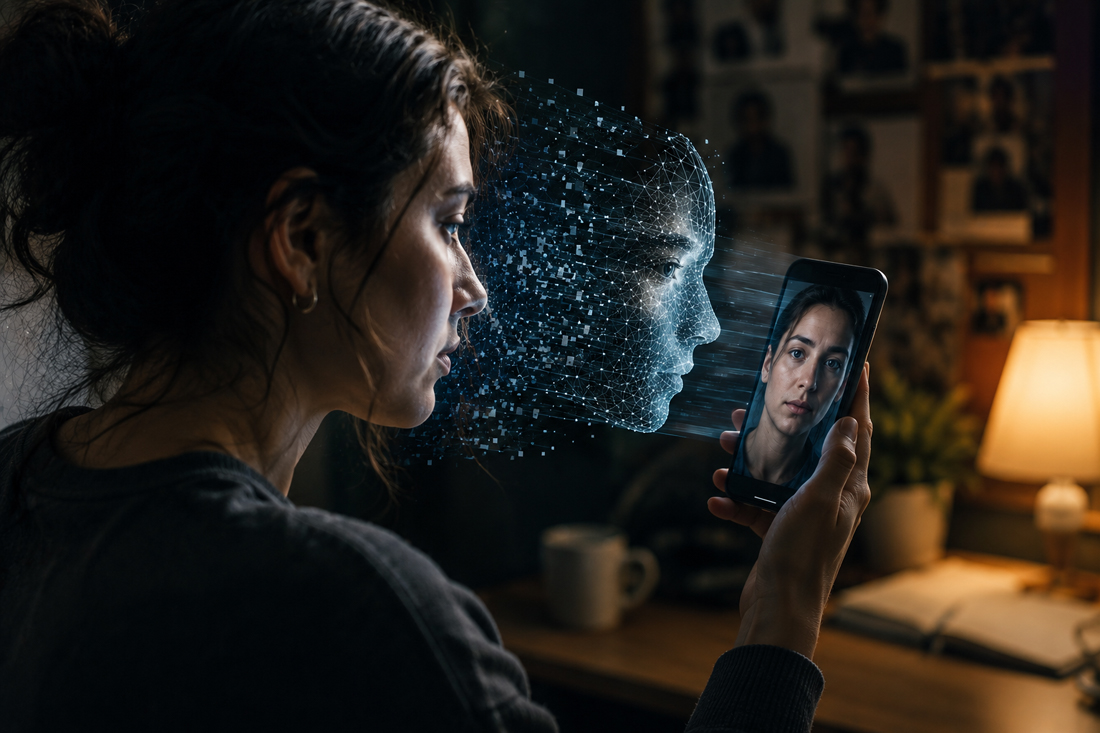
Convincing, high-quality fake videos created by AI are getting harder to detect. To be confident of authenticity, YouTube would like us to be able to depend on the "Altered or synthetic content" label appearing below the video title, but not all video creators comply with honesty. As the technical abilities of AI improve, visual analysis alone becomes insufficient for reliably detecting sophisticated deep fakes. Probably more reliable is a healthy dose of skepticism.
Six decades ago, U.S. Supreme Court Justice Potter Stewart dealt with what in my opinion is an analogous situation when he wrote of the difficulty defining pornography precisely in the context of constitutional law. His statement about obscenity also describes anything difficult to define objectively but recognizable intuitively. He wrote: "I shall not today attempt further to define the kinds of material I understand to be embraced within that shorthand description… and perhaps I could never succeed in intelligibly doing so. But I know it when I see it."
So how can you recognize a deep fake video? I suggest you should trust your instincts. YOUR intelligence is not artificial.
**************

Charles Miller is a freelance computer consultant with decades of IT experience and a Texan with a lifetime love for Mexico. The opinions expressed are his own. He may be contacted at 415-101-8528 or email FAQ8 (at) SMAguru.com.
**************
*****
Please contribute to Lokkal,
SMA's online collective:
 ***
***
Discover Lokkal: Mission

Visit SMA's Social Network
Contact / Contactar