 Español
August 2, 2026
Previous chapters
by Jan Baross
CHAPTER THIRTY-TWO
Augustine reins in the white Andalusian under El Pulpo's thousand-year-old cypress. The animal bows its dusty head and drinks from the small stream that runs to the sea. Across the coast road, lit by the moon, is my many tiered wedding-cake village. It no longer looks as stale as old bread. The white homes of El Pulpo shine with a smile-bright welcome.
"Our home, Gabito," I say to him as he slides off the rump of the Andalusian.
This place, I had almost forgotten in the small lifetime since I have seen Mamá and Papá.
With a groan from the feet up, I slip off the Andalusian's broad back. My legs are bowed and weak from gripping the hard leather mailbags that have rubbed my thighs burning raw. The chafing journey to El Pulpo has prepared me for the worst. But at least I am warm under Augustine's wool serape.
I lean with quaking knees against the old tree. Its ancient bark is puckered around generations of rusty nails and splintered pegs for posting hand-printed messages.
Sea-worn papers flutter in the cold breeze: "Fresh octopus," "My pig is missing," "Ramón please come home."
Old, red-veined Ramón causing the usual heartache. It is nice to know that nothing in El Pulpo changes. His poor Luisa is still paying the priest good money to pencil a message for her drunk husband who cannot read.
A sudden, cold breeze from the sea lifts the squares of paper in one silent breath. Augustine's lined face looks down at me with warmth beyond friendship, as if he had never betrayed me with his silence. He hands me Pilar's pink envelope.
"I will miss your little arms around me," he says with a tired smile. "But for now, you may keep the serape. I will find you after dinner and retrieve it then."
He kicks the Andalusian closer and reaches down to kiss me. Before Gabito can harm him, I wobble across the coast road out of reach.
"You will find your serape at my mother's house," I say. "Do not ask for me."
"Next time I want a kiss. Ssst! Ssst!" he says.
The horse's hooves spark wet stones in its graceful trot past me to deliver the mail.
Gabito holds my arm and helps me with my chafed, bowlegged walk down Calle de Serpiente, white slate roofs, powdered oyster shells distilling in the pale air, the familiar path to home. The smells of salt and sea are the aromas of our childhood. How different things would have been if I had not killed him on the cliffs. We would never have left El Pulpo. I would have become a diver and made Mamá proud. Now all I can do is tremble at the thought of seeing the disappointment in her eyes again.
"Easy, my love," says Gabito, helping me over the uneven cobblestones.
We pass the same winding rows of white houses, walls that are the white tunnels of memory. Windows of kerosene-bright curtains. I hear the faint laughter of the families inside and remember the insults.
Two new roof dogs on the Riveras' house lean over and bark strangled sounds like they are coughing up spinach. Their small teeth snap against the starry sky.
"Gabito, look," I whisper, and point to the old tortilleria.
The old tortilleria where Gabito and I breathed the same air every morning as children. At first I had not recognized my moonlit reflection in the window. I am thinner in the face. My jaw is hard from chewing and dreaming. My hair is up in a crooked bun just like Mamá's. Some fat has settled on my hips. The village will see my mother in me. There is no excuse not to have become something, anything, different. Over the years I have grown softer and harder, but not much else.
"Everything seems changed," says Gabito.
"Yes," I say, "except us."
Gabito floats through the low entrance of the tortilleria. A kerosene lamp blossoms orange on the tile counter. El Fuerte's gasoline motor still stinks, mingling with the heated smell of corn tortillas.
Gabito startles me out of my thoughts by touching my hand.
"Open the letter," he says.
I draw the pink envelope out of my skirt pocket and hold the envelope on the hot glass to melt the glue. He blows on the fragile pink paper so it will not ignite. Our invasion into Pilar's wifely words is almost repugnant, but it is for José that we do this.
Gabito snorts impatiently. Finally, the flap of the envelope curls back, and I draw Pilar's letter out. Her blue-ink handwriting is so precise, it is like the watertight weave of basketry.
Dear José,
I prayed every day to the Virgin of Guadalupe for your safety. Thank the good Lord that you wrote at last. Please do not say good-bye forever. Stay alive until we talk. I am wiser. I understand now what happened. It happens to many men on their wedding night. I love you. I am coming to be with you forever. I did not tell your mother where you are, as you asked. Please forgive me and wait.
Your loving wife, Pilar
PS. I am much prettier now.
The page trembles in my fingers. "He still wants to kill himself, Gabito."
And the little nun will arrive in time to be a widow. I spread the letter on the blue tile counter to stop my shaking hands.
"José does not want me to find him."
"Tortugina," says Gabito, "we will find him and save him."
A young dark-haired boy stands in the distant shadow of the back door. His hands hold a broom that is too big for him. For an instant, I see José returning as the child he once was, pushing the hair out of his eyes.
"Who are you?" he says. "I am Alfredo."
With no fear of strangers, he comes to the counter, and I turn up the wick of the kerosene lamp to show him my smile.
"I am Señora Tortugina, daughter of Señor Gomez who owns the store in the plaza. Are Señor Gomez and his wife at home?"
The boy merely stares at me as if I were a ghost. A silent stare from a child can mean many things. In this case, I hope it means nothing. Then he points silently in the direction of the plaza.
"Thank you, Alfredo," I say.
I stuff Pilar's opened envelope into my pocket. Gabito holds my arm and helps me hurry as I try to ignore my burning thighs. Down Calle de Serpiente the switch-back, where I barely catch a glimpse of the small shops on either side that are still in the same place, the lavanderia, the pollo restaurant.
Finally we arrive at the Plaza de Allende. Every closed shop is painted the same bloodless white. Trimmed trees are dark against lighted windows. Sounds from the past are loud in the silence: grackles chirping and screaming. The old ones are dead. The new generation shriek like a hundred rusty doors. I can still hear my blood pumping with the rhythm of the dances, memories of old tunes played from the iron bandstand.
Gabito and I stop in front of Papá's store. The wooden threshold has worn deeper. The shutters are closed, but there is light upstairs. The two-story façade is colorless in the moonlight. Without the heavy hues of Las Mujeres to inhale, my blood feels thin.
I close my eyes and breathe deeply until my blood feels strong again.
The breeze brings the smell of a cooked dinner from Mamá's iron skillet, handfuls of cilantro, leeks, garlic, tomatoes, octopus, and chilies fried crisp. I can even smell Papá's pipe smoke, Amanda's baby powder, and Véronica's rancid olive-oiled shoes. My sisters will have husbands who smoke cigars. I will have candy-scented nephews and nieces. José is eating up there with them. They are one big happy family. And I am on the outside, as always.
My fists pound on the bolted door. I want it to hurt, but that is not why I am crying. What I truly want is to press myself into the sweet scent of Mamá's flesh and let go of myself, let her heavy arms hold me up, let her heat close around me. The two of us as we used to be, together in the warm womb of her kitchen.
I have tried motherhood. I have been an adult. Now I want to come home.
"Mamá," I yell. "Let me in!"
The neighbors' shutters are cracking light. I tremble as the heavy steps on the other side of the door come closer.
"Mamá, Mamá! It is me!"
The door in front of me opens, and there is Papá with his dinner napkin still in the neck of his brown shirt. He does not seem to recognize me.
"Papá, it is Tortugina!"
He steps back from the door, blinking as though I were a bad dream, rips the napkin from his collar, and shouts up the stairs. "Celia, come quick, it is our outlaw!"
Mamá puffs down the stairs, soft body unchanged, but without her big smile. "Mamá, I missed you so much!" I try to come in, but Mamá blocks the door.
"You!" says Mamá and bursts into tears. She takes a moment to breathe and says, "All these years, Tortugina, no word from you. Then you send us your son who made us crazy! He has disgraced us worse than you!"
This is so much worse than I expected. I can barely breathe in the heated space between us.
"What did José do?" I whisper.
Papá puts his arm around Mamá's shuddering shoulders.
"The village paid him to make a statue of the Blessed Virgin on the cliffs," says Papá. "One that the fishermen could see."
Mamá wipes her eyes with her apron. "He refused to show it to us. After a year of wondering, some of the men tore off the tarp today to see what he made with our money."
Papá shakes his head. He too is nearly in tears.
"All that cost, and now the village has to tear it down."
I remember the beautiful, delicate statue José carved for Pilar.
"Mamá, José only knows how to make beauty with his hands. He is a master craftsman. He is even better than his father!"
Mamá raises her swollen eyes to look at me and begins to close the door.
"Go to the cliffs, Tortugina, and see for yourself," she says.
I press against the door to keep her from shutting it.
"You used to love me, Mamá," I whisper.
Her voice softens. "Little turtle, I do love you. Now, please, go away. It was bad enough when you lived here. But this son of yours . . . it is too much for my old heart."
She starts to sob. Papá gently pushes the door, and I step back as it closes against the worn threshold.
The cold breeze of El Pulpo whips my tears. Gabito takes my hand and pulls me as fast as I can run to the cliffs.
To be continued
**************
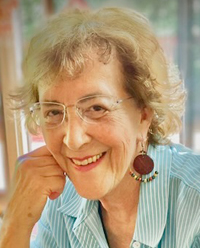
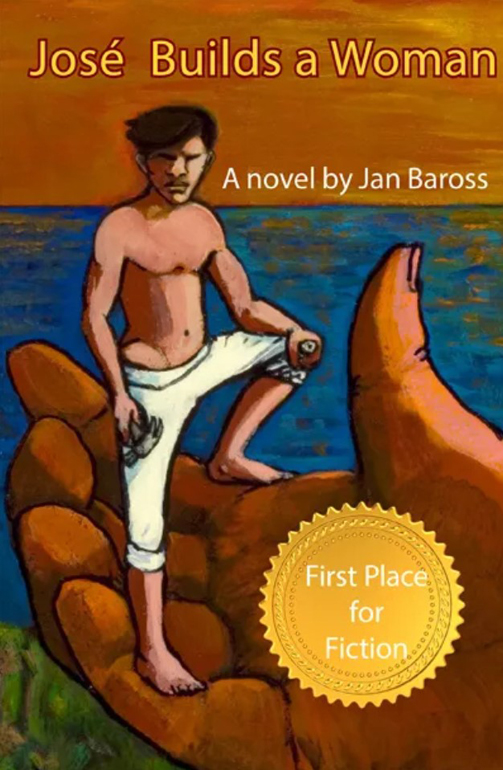
Jan Baross is an award-winning novelist, documentary filmmaker, photographer, screenwriter, librettist, film critic and taught filmmaking at Oregon State University. "Jose Builds a Woman," her debut novel published by Ooligan Press twenty years ago, in 2006, received first place for fiction. Ursula Le Guin gave it a thumbs up.
Baross lives six months a year in Portland, Oregon and SMA where loves designing posters for the Annual San Miguel Playwrights Winter Showcase. Books and Audible on Amazon. Films on YouTube.
www.janbaross.com
**************
*****
Please contribute to Lokkal,
SMA's online collective:
 ***
***
Discover Lokkal: Mission

Visit SMA's Social Network
Contact / Contactar